
How to Respond to ‘Not Interested’ Replies to Cold Emails (Without Sounding Desperate)
You send a cold email, a reply lands, and it says “Not interested.” Most reps read that as the end of the conversation and move on. That instinct quietly kills more pipeline than any other single reply type, because a “not interested” cold email reply is frequently not a decision at all. It is a reflex.
Almost every guide on this topic is written for cold calls, where the objection is spoken live and you have three seconds to react. Email is a different game. You have time to read the exact words, you can respond when it helps rather than in a panic, and you can build one repeatable approach instead of improvising every time. This post covers how to tell a real no from a reflex no, what to actually write back, and how to handle every “not interested” reply consistently even when hundreds land across your inbox.
What a ‘Not Interested’ Cold Email Reply Actually Means
When someone types “not interested” and hits send, they are almost never telling you they evaluated your offer and rejected it. They have not seen a demo, read a case study, or thought about the problem. So the words are standing in for something else, and your job is to figure out what.
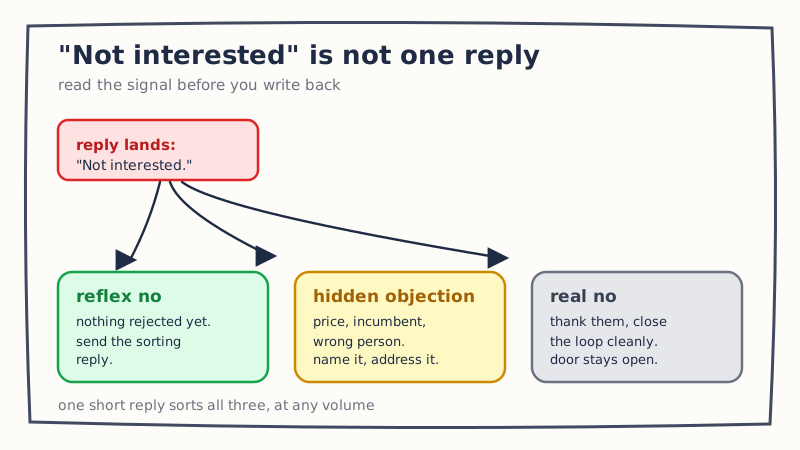
There are three things a “not interested” reply usually means, and they call for completely different responses:
It is a reflex. The prospect pattern-matched your email to the dozen other cold emails they got this week and cleared it with the fastest possible reply. This is the most common case. There is no real objection underneath yet, which is good news: nothing has actually been rejected.
It is a hidden objection. “Not interested” is a polite wrapper around a specific concern the prospect did not want to spell out. The real message is “we already use something,” “I do not have budget,” “I do not believe your claim,” or “you are talking to the wrong person.” The words hide the objection, but the objection is what you have to surface.
It is a real, final no. Sometimes the timing, the fit, or the need genuinely is not there, and the prospect means it. This case is rarer than reps assume, and the good part is that a single well-judged reply will tell you which of the three you are dealing with.
The mistake is treating all three identically. Reps who delete every “not interested” reply lose the reflex and hidden-objection cases, which is most of them. Reps who fight every one with a hard rebuttal burn the genuine declines and their own reputation. The skill is reading the signal, and email gives you the time to do it well. For the broader picture of sorting inbound by intent, our guide to responding to cold email replies walks through the full triage.
The One-Line Reply That Does the Sorting
You do not need a clever rebuttal. You need one short, low-pressure reply that gives the prospect an easy way to reveal which of the three cases they are in. The best version acknowledges the no, removes the pressure, and asks a single specific question.
Here is the pattern, with a concrete example:
“Totally fair, and thanks for the quick reply. Out of curiosity, is it that reply handling is not a priority right now, or that you already have a way to cover it? Either answer helps me know whether to close the loop.”
Look at what that does. It accepts the no rather than arguing, so a genuine decliner is not annoyed. It offers two named reasons, which is far easier to answer than an open “why not,” and each reason routes to a different next step. And it explicitly gives permission to end the conversation, which paradoxically makes a reflex replier more likely to keep it going.
A few more example responses tuned to different first replies:
- Reply: “Not interested.” → “No problem at all. Quick gut check so I do not keep bugging you: is this a wrong-time thing or a wrong-fit thing?”
- Reply: “We’re all set, thanks.” → “Makes sense. If you are already handling [the specific problem] in-house, I will step back. If it is more of a we-live-with-it situation, worth two minutes?”
- Reply: “Please remove me.” → Stop. Honor it immediately, no question, no pitch. This one is always a real no.
Notice the last one. Part of responding well is knowing when not to respond at all. A removal request or a clearly irritated reply is a hard stop, and pushing past it is how you earn spam complaints that damage your deliverability for every future send.
What Not to Write Back
The wrong replies are predictable, and they all share one trait: they make the reply about you instead of the prospect.
Do not re-pitch. Answering “not interested” with another three paragraphs about your features tells the prospect you did not read their reply. It confirms the reflex that got you dismissed in the first place.
Do not guilt-trip. “Just 15 minutes could change your business” and “I am surprised you would not want to save money” both read as pressure. They convert a soft no into a hard one and a hard one into a spam report.
Do not fake a relationship. “I was really hoping we could connect” from a stranger is not persuasive, it is off-putting. Keep it honest and low-stakes.
Do not send a wall of text. The whole advantage of a good response is that it is easy to answer. A long reply defeats that. Two or three sentences is the ceiling.
If the reply hides a specific objection like price or an incumbent tool, the move is to name and address that objection directly rather than talk around it. Our deeper playbook on handling objection replies in cold email breaks down the response for each common one.
The Real Problem: Doing This Consistently at Scale
Everything above works when you have one “not interested” reply and five quiet minutes to craft a thoughtful response. That is not the situation most teams are in.
When you are running real volume, “not interested” replies arrive constantly, mixed in with meeting requests, pricing questions, and out-of-office bounces. Under that load, three things break:
Speed. The sorting reply only works while the prospect still remembers your email. A thoughtful response sent three days later lands cold. Reply speed is one of the highest-leverage variables in the entire process, which is why faster response times consistently lift conversion.
Consistency. Your best rep sends the low-pressure sorting reply. Your newest rep argues, or ignores it, or sends the wall of text. The quality of your “not interested” handling ends up depending on who happens to open the inbox that morning.
Follow-through. Many “not interested” replies are really “not right now.” Those need a scheduled re-touch weeks or months later, and a human ledger of those commitments always leaks. We wrote a whole piece on why circle-back-later replies get lost and how to stop it.
This is the gap that Underfive is built to close. An AI reply agent reads each incoming reply, classifies whether “not interested” is a reflex, a hidden objection, or a firm no, and responds in seconds with the right low-pressure message instead of a re-pitch. It honors removal requests instantly, routes genuine declines out of the sequence, and schedules the re-engagement for the “not right now” replies so the follow-up actually happens. You define the tone and the rules once, and every reply gets handled the same considered way whether it is the first of the day or the four hundredth. You can see how the classification and response logic works on the features page.
The point is not to remove judgment from the process. It is to encode your best judgment once and apply it to every reply, so a “not interested” no longer means a lead quietly disappears because nobody had time to send two good sentences.
A Simple Framework You Can Use Today
Whether a person or an agent handles the reply, run every “not interested” through the same four steps:
- Check for a hard stop. Removal request, legal threat, or clearly angry reply? Honor it, suppress the contact, and move on. No exceptions.
- Send the sorting reply. One acknowledgment, one specific either-or question, one explicit off-ramp. Keep it under three sentences.
- Route by the answer. Wrong fit or firm no: thank them and close the loop cleanly, since a graceful exit today keeps the door open later. Hidden objection: address that specific objection. Wrong time: capture the timing and schedule the re-touch.
- Log the outcome. Even a clean no is data. A pattern of “already using X” replies tells you something about your targeting or your positioning that is worth acting on.
None of this requires a script full of pressure tactics. It requires reading what the reply is really saying and responding in a way that keeps a real conversation possible. Do that consistently and “not interested” stops being a dead end and starts being the beginning of a sort. If you want that consistency without adding inbox hours, that is exactly the job an AI reply agent is built to do, and it is worth seeing it in action on your own replies.