
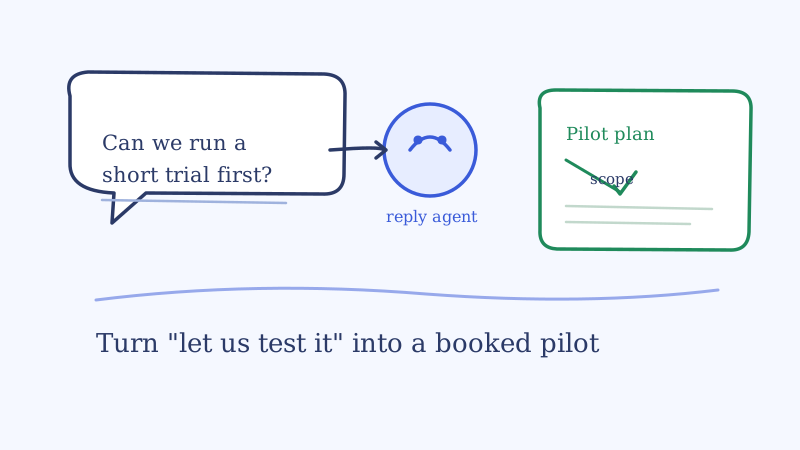
A prospect replies to your cold email with five words: “can we do a trial first?” On the surface it feels like a soft yes, and it usually is. But it is also the single most common place a warm reply quietly dies. The rep sends a generic “sure, I’ll set you up,” a login lands in an inbox no one asked to own, and three weeks later the deal is marked closed-lost with the note “went dark during trial.”
The trial request is not the problem. The handling is. A trial or pilot ask is a buying signal wearing a hedge, and the way you answer it in the first reply decides whether it becomes a scoped evaluation that converts or a free login that nobody remembers. This guide walks through what the reply actually means, the response that turns it into a real pilot, and how an AI reply agent handles the whole exchange the moment it arrives instead of after it has cooled off.
What a trial request actually means
When a prospect asks for a trial, they are telling you three things at once, and only one of them is on the surface.
The stated message is “I want to see it work before I commit.” Fair, and easy to say yes to. The second, quieter message is “I am not fully sold, and I want to lower my risk.” The third, quietest of all, is “I do not yet have a reason to spend real time on this, so give me one.” Reps hear the first message and skip the other two. They grant access and assume the product will sell itself. It rarely does, because a prospect who is not yet sold will not invest the effort a trial demands, and an unused trial is worse than no trial: it manufactures a “we tried it and it did not stick” story that follows you into the next quarter.
So the job of your reply is not to grant access as fast as possible. It is to convert a vague test into a scoped evaluation with an owner, a success metric, and a date. That reframe is the entire difference between a pilot that closes and a login that rots.
The response pattern that turns a trial into a pilot
Say yes to the trial, but say yes to a shaped version of it. A strong first reply does four things in a few sentences.
First, it affirms the request without hesitation, because friction here reads as insecurity. Second, it asks one qualifying question that turns “a trial” into “a trial of what, exactly.” Third, it proposes a concrete success criterion, so both sides know what “it worked” looks like. Fourth, it books a short kickoff, because a pilot with a calendar hold behind it converts several times better than one without.
Here is the shape in practice. The prospect writes: “Looks interesting, can we run a small trial before we decide?” A weak reply is “Absolutely, here’s your login.” A strong reply is: “Happy to. Most teams get the clearest read by pointing it at one live campaign for two weeks and watching reply-to-meeting rate, so we compare against something real. Who on your side would own the pilot, and does a 20-minute kickoff Thursday work to set it up?”
Notice what that reply did. It scoped the test to one campaign, named a metric the prospect already cares about, assigned an owner, and proposed a date, all while sounding helpful rather than controlling. That is the reply that separates a pilot from a graveyard login. If you want the broader logic of matching your answer to the buyer’s stage, we laid it out in how to respond to positive cold email replies.
Why speed decides whether the pilot happens at all
A trial request has a short half-life. The prospect asked because they had a spark of intent, and that spark fades fast. A reply that lands in five minutes catches them while the tab is still open and the interest is still warm. A reply that lands the next afternoon catches a different person: one who has moved on to four other fires and now treats your pilot as homework.
This is not a soft claim. The gap between a same-hour response and a next-day one is where most trial requests silently convert into non-events. We put numbers to that window in how 5-minute response times increase conversions, and the pattern holds hardest exactly here, at the moment a prospect leans in. The trouble is that trial requests do not respect business hours. They arrive at 9pm, on Saturdays, and while your one SDR is heads-down in a different thread. A human queue cannot promise a five-minute reply to every one of them, which is precisely the gap an AI reply layer is built to close.
How an AI reply agent handles the trial ask end to end
An AI reply agent reads the incoming reply, recognizes that a trial request is a high-intent buying signal rather than a generic question, and responds on the pattern above, all within minutes of the message landing. It does not fire a canned “here’s your login.” It runs the scoping play.
Concretely, the agent does four things a template cannot:
- It classifies intent correctly. “Can we trial it” and “not interested right now” both contain hedging language, but they mean opposite things, and a keyword filter cannot tell them apart. The agent reads meaning, so a trial request gets the pilot play and a brush-off gets a different path entirely. That distinction is the same one we cover in how to handle objection replies in cold email with AI.
- It scopes and books in one reply. It affirms, asks the one qualifying question, proposes a success metric, and offers concrete times, so the prospect can say yes to a real kickoff instead of drifting into an unowned login. Booking the meeting from inside the reply is the mechanic we break down in how AI reply agents book meetings from cold email replies.
- It escalates the high-value ones. When the reply comes from a director at a target account, or asks for a security review before the pilot, the agent routes it to a human with the thread already summarized, rather than auto-answering something that deserves a person. You set those rules; the agent follows them. We detail that logic in AI reply agent human escalation rules.
- It keeps the thread alive after the first reply. Pilots stall in the follow-up gaps, not the first message. The agent holds the conversation across the “let me check with my team” and “can we push kickoff a week” replies without dropping context, so the pilot actually starts.
Underfive connects to your existing inbox and runs this handling automatically, which means every trial request gets the scoping play in minutes whether it lands at noon or midnight. You can see the specific reply capabilities on the Underfive features page.
Setting the pilot up so it actually converts
The reply is half the work. The pilot itself needs guardrails, and the good news is that the reply already planted them: an owner, a metric, and a date. Hold to all three.
Keep the pilot short. Two weeks beats a month, because a long trial is a long time to lose momentum, and urgency is your friend. Point it at something live, not a sandbox, so the result is real and the prospect feels the value in their actual pipeline. And book the readout meeting on day one, at the same time as kickoff, so the pilot ends in a conversation rather than a fade. A pilot with a scheduled readout is a pilot with a natural close; a pilot without one is a login that expires in silence.
One more guardrail worth naming: make sure the list you are running the pilot against is clean. A trial that reports a weak reply rate because half the addresses bounced is a trial that talks the prospect out of buying for the wrong reason. Validating the pilot list first, with a tool like Scrubby, keeps the test measuring your product instead of your data hygiene.
The mistake to avoid
The failure mode is treating a trial request as a finish line when it is a starting gun. “Sure, here’s access” feels generous and reads as done, but it hands the prospect all the work: define the test, find the time, remember to look. Most will not, and you will inherit a “we tried it” objection you created yourself.
Do the opposite. Say yes fast, scope the test to one real thing, name what success looks like, and put a kickoff on the calendar, all in the first reply and all while the interest is still warm. That is a lot to execute by hand on every trial ask that lands, at every hour, without a beat of delay. It is exactly what a reply agent is built to do, and it is the difference between a pilot that closes and a login nobody opens.
Start by writing down the last five trial requests your team received and what happened to each. The ones that converted almost certainly got scoped and booked fast. The ones that vanished almost certainly got a login and a shrug. Automate the first pattern, and the trial request stops being where your warm replies go to die.