How to Respond to a Positive Cold Email Reply and Actually Book the Meeting
You spent weeks getting a prospect to reply, and they finally wrote back something warm: “sounds interesting” or “tell me more.” A positive cold email reply is the single easiest deal to lose, because most reps treat it as a finish line instead of a starting gun. The interest is real but fragile, and the next message either turns it into a meeting or lets it cool back into silence.
This guide breaks positive replies into the four types you actually receive, tells you what each one really means, and gives you the exact response structure for each. The goal is never “keep the conversation going.” The goal is always the next concrete step, usually a booked call.
Why a warm reply cools so fast
A positive reply is a spike of intent, not a commitment. The prospect was curious enough to type a sentence, but they have not decided to spend time with you. Three things kill that spike.
Speed is the first. Interest decays by the hour. If you reply the next morning, the context that made them curious is gone and your message lands cold again. Teams that answer inbound in minutes convert far more of them, which is why fast response times move conversion so much.
Over-reacting is the second. A one-line “interested” does not earn a three-paragraph pitch, a deck, and a Calendly wall. Dumping everything signals that you were waiting to unload, and it forces the prospect to do work to find the point.
Under-reacting is the third. Replying “Great! Let me know if you have questions” hands the next move back to a stranger who has no reason to make it. Every positive reply needs you to propose the step, not wait for them to.
The four types of positive cold email reply
Not every warm reply means the same thing, so a single canned response cannot handle them well. Sort each reply into one of four buckets before you write back.
1. The soft yes: “Sounds interesting” or “Tell me more”
This is curiosity without a specific question. It means the premise landed but the prospect has not pictured what talking to you looks like. Your job is to add one sentence of specificity, then propose a time. Do not send a brochure.
A response that works:
Glad it resonated. Most [role] we work with were losing [specific problem] before switching. Worth a quick 15 minutes Thursday or Friday to see if the same fits your setup? Here is my calendar: [link]
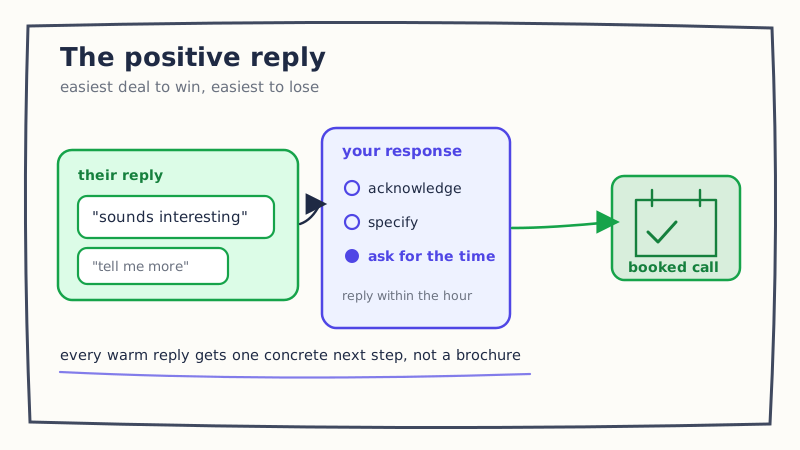
Notice the shape: acknowledge, one concrete proof point tied to their world, one clear ask with two time options. The two options beat an open “when works?” because a small choice is easier to answer than a blank one.
2. The information request: “Send me pricing” or “What does it do?”
This looks like a stall but is usually genuine. The mistake is to answer only the question. Give a tight answer, then attach the meeting to it. Raw pricing sent with no context anchors the conversation to a number instead of the outcome, which is a common way to lose the reply on the way to a demo.
A response that works:
Happy to. Plans start at [range] and scale with [the one variable that matters]. The exact fit depends on [their variable], which is why a 15-minute call usually saves you the back-and-forth. Does Wednesday at 10 or 2 work? I will confirm pricing for your volume on the call.
You answered honestly, framed the number around their situation, and still moved to a time. If they only wanted to comparison-shop, they will say so, and you have lost nothing.
3. The interested-but-not-now reply: “Circle back in Q3”
This is a real positive signal wearing a delay. The intent is there, the timing is not, and the wrong move is to vanish for three months and hope they remember you. Confirm the interest, pin an exact date, and leave one lightweight value touch in between. We go deep on this in the guide to handling not-right-now and circle-back replies.
A response that works:
Makes sense, Q3 it is. I will send a note the first week of July so it lands when you are actually looking. In the meantime, here is a short piece on how [similar company] handled [their problem], no reply needed.
Then you actually track the date. A “circle back” you never circle back to is just a polite no you agreed to.
4. The direct yes: “Let’s set up a call”
The prospect did your job for you, so do not add friction. The failure here is the multi-step scheduling dance: “Great, what times work?” then a reply, then “how about Tuesday?” then silence. Send the calendar link and two proposed slots in the same message you would have used to ask.
A response that works:
Perfect. I have Tuesday at 11 or Thursday at 3 open. Grab whichever is easier here [link], or reply with a better window and I will send an invite.
One message, zero rounds of negotiation. Every reply round you add is another chance for the prospect to get pulled into something else and drop off.
The rule underneath all four
Every positive reply, regardless of type, gets a response with the same three parts: acknowledge what they said, add one piece of specificity relevant to them, and propose one concrete next step with two time options. Acknowledge, specify, ask. If a draft is missing the ask, it is not finished.
The other constant is speed. A positive reply answered within the hour feels like a live conversation. The same reply answered a day later feels like a form letter, and the prospect responds accordingly.
Doing this at scale without a rep glued to the inbox
The advice above is simple to follow for one reply. It falls apart across hundreds of live threads spread over time zones, nights, and weekends, which is exactly when warm replies go stale. A rep cannot watch every inbox at 9pm, and the meeting-booking moment does not wait for business hours.
This is the gap an AI reply agent closes. Underfive reads each incoming reply, sorts it into the right type, and responds in your voice within minutes, proposing times and dropping a booking link the moment a prospect shows interest. It does not fire a generic template at every message. It answers the pricing question, honors the Q3 delay and schedules the follow-up, or sends slots for the direct yes, then hands warm, qualified threads to a human when judgment is needed. You can see how the reply handling and meeting-booking flow works here, and the mechanics of turning replies into booked meetings automatically if you want the full picture.
The point is not to remove people from the conversation. It is to make sure no positive reply ever sits unanswered long enough to go cold.
Your next step
Pull up the last ten positive replies your team received and check two things: how long each one waited for a response, and whether that response proposed a specific time. If most waited hours or ended without an ask, you are not losing deals to your product or your pitch. You are losing them in the reply. Fix the acknowledge-specify-ask pattern first, then close the speed gap, and the same volume of warm replies will start turning into booked calls.