Cold Email Reply to Demo: Why Warm Leads Go Cold After Replying and How to Stop It
You ran the campaign, nailed the targeting, and a prospect replied. They said something like “sounds interesting, tell me more” or “we might need this, what does pricing look like?” That is a warm lead. It should convert to a demo at a high rate. Often it does not.
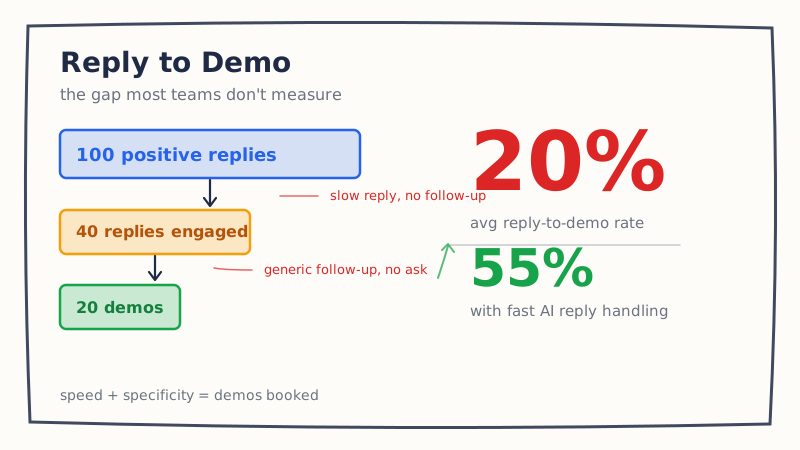
The average positive cold email reply converts to a booked demo at somewhere between 20% and 40%, depending on how fast you respond and how well that first reply matches what the prospect actually asked. The rest of those interested people quietly drift away, book with a competitor who answered faster, or simply forget they ever wrote back. This post is about closing that gap.
Why the reply-to-demo rate is the metric most teams ignore
Most sales teams measure two things well: send volume and reply rate. The positive reply rate gets some attention too. But the reply-to-demo conversion rate, the number of positive replies that turn into a calendar invite, is rarely tracked as its own number.
The result is that teams celebrate a spike in replies without knowing whether those replies are actually booking. A team that gets 50 positive replies and books 30 demos is performing very differently from one that gets 50 positive replies and books 8, but both report “50 positive replies” in the weekly standup.
Start measuring this rate. The numerator is demos booked from inbound cold email replies. The denominator is positive cold email replies received in the same period. If you do not know this number right now, that is already information: something between the reply and the demo is not being managed deliberately.
The four places warm leads go cold
1. Slow first response
A prospect who replies to a cold email is doing something unusual. They interrupted their day, read your message, decided it was worth their time, and wrote back. They are in a window of attention and intent that closes fast.
Research on inbound lead response times consistently shows that contacting a lead within five minutes of their action produces a dramatically higher conversion rate than contacting them within an hour, and the gap between one hour and 24 hours is similarly steep. The same dynamic applies to cold email replies. A prospect who asks “what does pricing look like?” at 10 AM and gets an answer at 4 PM has already moved on mentally. Their next meeting, their next problem, and three other emails have displaced your campaign from their working memory.
The practical ceiling for a human SDR response time, given inboxes, meetings, and time zones, is often two to four hours. That is too slow for the first hour after a reply lands.
2. Generic follow-up that ignores what the prospect said
The second failure mode is speed without specificity. A prospect who asks about pricing and gets a reply that says “Great to hear from you, I would love to schedule a 30-minute call to walk you through everything” has not had their question answered. They asked about pricing. A relevant, specific reply would acknowledge that and give a direct answer, even a range, before asking for the meeting.
Generic follow-up is often the result of a rep copying a template without adapting it. It signals to the prospect that no one actually read their reply, which undermines the trust the original email was trying to build.
3. Fumbling the meeting request
Even when the response is fast and relevant, the conversion to demo often fails at the actual ask. Sending a Calendly link with no context (“Feel free to grab a slot here”) puts the friction on the prospect. A better pattern is proposing two or three specific times and making the booking as low-effort as possible. This is a small thing but it removes a decision the prospect has to make at a moment when they might not feel ready to commit.
4. No follow-up when the reply goes quiet
A prospect who replied “sounds interesting, will circle back next week” rarely circles back on their own. The ball is back in your court. Most teams miss this because tracking these “pending” replies is hard when the inbox is shared and manual.
A single well-timed follow-up five to seven days later, referencing the original conversation, recovers a meaningful share of these stalled conversations. Not doing it is leaving booked meetings on the table.
How to improve each failure point
Speed: automate the first response
The fastest fix for slow response times is to stop treating the first reply as something only a human can handle. The first response to most positive cold email replies follows a finite set of patterns: answer a pricing question, share a relevant case study, propose a meeting, handle a common objection. These are not judgment calls that require a senior rep.
The inbox agents in Underfive’s Unified Inbox can read the incoming reply, understand its intent, and send a relevant, on-brand first response in under a minute, any hour of the day. The rep handles the calls; the agent handles the inbox. This alone closes a significant portion of the reply-to-demo gap because the prospect never has to wait.
Relevance: match the reply to what was asked
This is harder to automate without the right tool, but the principle is simple. Before sending any response to a positive reply, answer one question: what did this person actually ask, and does my response address it directly?
For pricing questions, give a range or point to the pricing page. For “send me more information” replies, do not send the full deck; send the one piece of information most relevant to their context. For “we already use X” replies, acknowledge X and explain how the two work together or what the difference is. Specificity signals that a real person, or a well-trained agent, read their message.
Booking: make the next step obvious
Instead of a generic Calendly link, propose specific times. “Are you free Tuesday at 2 PM or Wednesday morning? Happy to send an invite for whichever works.” This works better because it gives the prospect something to react to rather than something to initiate.
If you are using an AI reply agent, this step can be fully automated: the agent identifies intent to book, proposes times based on the rep’s calendar, and sends a confirmation once the prospect picks one. The rep joins the call; they do not manage the scheduling back-and-forth.
Underfive’s booking integration does exactly this: it reads the reply, confirms intent, and handles the calendar coordination without a human in the loop.
Stalled replies: build a short follow-up sequence
For replies that express interest but do not immediately commit, build a two-message follow-up sequence triggered when no booking happens within five days. The first message references what the prospect said and asks a simple question. The second, three days later, is a short check-in. Both should be easy to say yes to.
This is not about being pushy. It is about acknowledging that people get busy and that a reminder is useful, not intrusive, when the original interest was real.
What a healthy reply-to-demo rate looks like
There is no universal benchmark, but as a rough guide:
- Below 20%: There is likely a speed or relevance problem. The replies are landing but the follow-up is not converting.
- 20% to 35%: Typical for teams with a manual inbox workflow and reasonably good follow-up habits.
- 35% to 55%: What disciplined teams with fast response processes and targeted follow-up tend to see.
- Above 55%: Usually indicates either a very high-intent lead source, a highly automated and well-tuned reply workflow, or both.
If you are below 30%, the fastest path to improvement is almost always response speed. Speed beats copy, personalization, and sequence design at this stage of the funnel.
The compounding effect of fixing the reply-to-demo rate
Here is why this metric deserves more attention than it gets. Improving the reply rate from 5% to 7% requires better copy, better lists, and usually several weeks of iteration. Improving the reply-to-demo conversion rate from 25% to 40% on the same number of positive replies is a 60% increase in demos booked, and it comes from process changes that can be implemented this week.
A team getting 40 positive replies per month at 25% conversion is booking 10 demos. The same team at 40% conversion books 16. That is six additional demos from the same send volume, the same copy, and the same list. The only thing that changed is what happens after the reply lands.
This is where Underfive sits in the stack: not as another sequencing tool, but as the layer that makes sure no positive reply waits more than a few minutes for a relevant, on-brand response. If you are already generating replies and not converting them to demos at the rate you expect, that gap is almost always the first thing worth fixing.
For more on the mechanics of what happens in the critical minutes after a reply lands, see our post on cold email response time best practices and why cold email replies get ignored.