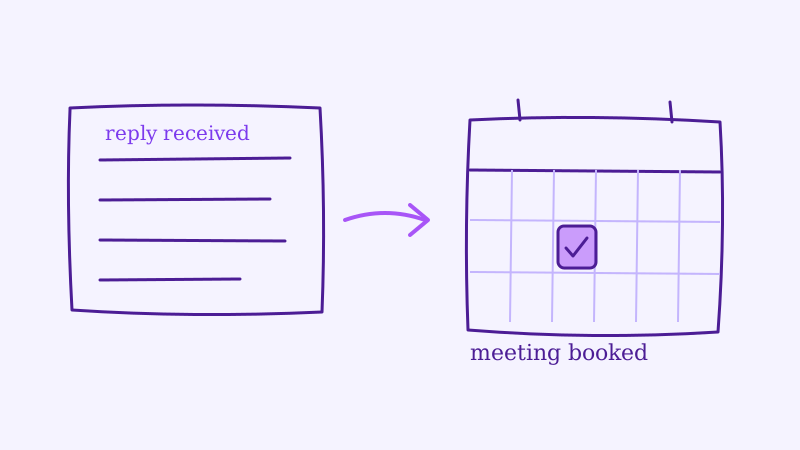
Most cold email teams celebrate the wrong metric. Reply rate looks great on a dashboard, but a reply is only potential energy. The deal starts when a meeting lands on the calendar, and the gap between “sounds interesting, send me a time” and a confirmed slot is where most pipeline quietly dies.
The reason is boring and mechanical. A prospect replies at 9:14am, the assigned rep is in a standup until 9:45, then triaging a different account until noon. By the time they open the thread, the buying urge that made the prospect reply has cooled. The research on response timing is brutal here: the odds of booking a meeting drop sharply with every hour that passes after a positive reply.
An AI reply agent closes that gap by treating a positive reply as a booking event, not a notification. Here is how that actually works.
The booking loop, step by step
When a reply hits the inbox, the agent runs a fast classification pass before it writes anything. It is not just checking sentiment. It is deciding which of a handful of states the thread is in:
- Ready to book (“Sure, what does your Tuesday look like?”)
- Soft interest, needs a nudge (“Maybe, what would this cost us?”)
- Wrong contact (“You want my colleague in RevOps”)
- Hard no (“Please remove me”)
Only the first two lead toward a calendar. For a ready-to-book reply, the agent moves immediately into scheduling mode.
The naive version of this is to paste a scheduling link and hope. That works maybe a third of the time. The better pattern, and the one that separates a real agent from a glorified autoresponder, is to propose two or three concrete times pulled live from the rep’s connected calendar, then confirm the moment the prospect picks one. Concrete slots convert better than a bare link because they remove a decision step. The prospect says “Wednesday works” and the meeting is held.
Why time zones and calendars break naive automation
The hard part is not sending the message. It is holding accurate state across a short back-and-forth.
A prospect in Berlin who says “3pm works for me” does not mean 3pm in your rep’s Denver calendar. An agent that books the literal number creates a no-show and burns the lead. A well-built agent normalizes the prospect’s stated time against their signature, their email headers, or an explicit ask, then writes the event in the rep’s zone while confirming in the prospect’s zone. Getting this wrong once teaches a prospect that your company is sloppy before the first call even happens.
There is also the double-booking problem. If two prospects both grab the same 2pm slot in the ninety seconds it takes them to reply, the agent has to detect the collision and re-offer, gracefully, without making either person feel like an afterthought. This is why booking logic has to sit on a live calendar connection rather than a static list of “open” times. If you are already running calendar-based outreach through a tool like Kali, the agent can hang off that same availability layer instead of maintaining a competing source of truth.
Handling the “not yet” replies without dropping them
The replies that need a nudge are where most automation gives up and dumps the thread on a human. That is a mistake, because “what would this cost” or “we are slammed until Q3” are not rejections. They are open loops.
A capable agent answers the immediate question in one or two tight sentences, then pivots straight back to a time. Something like: address the pricing range at a high level, note that the specifics depend on volume, and offer to walk through it live on a fifteen minute call with two proposed slots attached. The point is to never end an agent message without a clear next action. Every reply either books, answers-then-books, or hands off cleanly to a person with full context.
For the genuine “not now” cases, the agent should not force a booking. It sets a follow-up for the timeframe the prospect named and re-engages then, so a Q3 lead does not evaporate in June.
Where the human still belongs
Automating the booking does not mean removing the rep. It means the rep only sees threads that are worth a human minute:
- Complex multi-stakeholder scheduling across several calendars
- High-value named accounts flagged for a personal touch
- Anything the agent’s confidence score marks as ambiguous
Everything else, the routine “yes, book me” motion that eats hours of an SDR’s week, runs on its own. Reps walk in to a calendar that filled itself overnight rather than an inbox they have to dig through.
What to watch before you turn it on
Two failure modes are worth guarding against.
First, deliverability. An agent that fires long, link-heavy booking messages can trip spam filters and undo the reply you worked so hard to earn. Keep booking messages short and human, and make sure the sending domain and list hygiene are clean in the first place. If your reply rates look low across the board, the problem may be that your messages are not landing at all, which is a validation and deliverability question worth solving before you blame the copy.
Second, tone drift. A booking agent that sounds robotic in the exact moment a prospect leaned in is worse than a slow human. The agent has to carry your brand voice into the scheduling exchange, not switch into a stiff calendar-bot register.
Get those two right and the math is simple. You already paid for the reply. Letting the inbox agents in Underfive’s Unified Inbox convert it into a held meeting in minutes, instead of hours, is the cheapest pipeline you will add all year.