
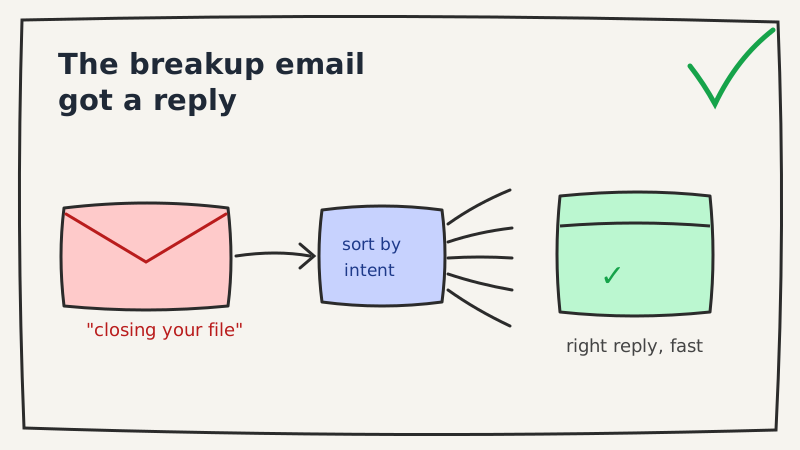
Your breakup email did its job. A prospect who ignored five previous emails just replied to the one that said you were closing their file. That is the moment most sales advice abandons you, because nearly every article about breakup emails teaches you how to write the send and goes silent on what to do with the cold email breakup email replies it produces.
That silence is expensive. The breakup email is often the highest-reply touch in a cold sequence. HubSpot has reported sales teams seeing response rates as high as 33% on breakup emails, far above the reply rate of the emails before it. So you are not handling a trickle. You are handling a concentrated burst of replies from people who ignored you until the exact moment you threatened to leave. Fumble the response and you waste the only leverage the breakup email created.
Why Breakup Email Replies Are Different From Normal Replies
A breakup email works on loss aversion. You stop asking for the meeting and instead signal that the opportunity is disappearing. That framing changes who replies and why.
A prospect who replies to your first cold email is usually acting on interest. A prospect who replies to your breakup email is often acting on a mix of guilt, mild panic, and the realization that they meant to respond weeks ago. The reply is real, but the context is fragile. They are not deep in a buying process. They surfaced because you gave them a reason to, and that reason expires fast.
This is why you cannot treat a breakup reply like a fresh inbound lead. It carries three properties at once:
- High intent to respond, low intent to buy. They engaged, but they have not committed to anything.
- A short attention window. The urgency you manufactured is what pulled them back. It fades within hours.
- A specific mix of reply types. Breakup emails trigger a narrower, more predictable set of responses than a cold email does.
Once you know that mix, responding well becomes a matter of matching the reply to the right move.
The Five Replies a Cold Email Breakup Email Actually Triggers
Across a typical B2B sequence, breakup emails cluster into five responses. Naming them is the whole game, because your reply changes completely depending on which one you are looking at.
| Reply type | What it sounds like | What it actually means |
|---|---|---|
| Renewed interest | ”Wait, don’t close this out, I do want to talk” | Guilt-driven re-engagement, genuine but shallow |
| Timing objection | ”Bad timing right now, reach back out in Q1” | Real interest, wrong moment |
| Wrong person | ”I’m not who handles this, try Dana” | A referral hiding inside a decline |
| Hard no | ”Not interested, please remove me” | A clean exit signal, honor it |
| Re-engage and re-pitch | ”Sorry, swamped. Remind me what this was?” | They forgot you entirely, start over briefly |
Most reps respond to all five the same way, usually by immediately pushing for a calendar slot. That converts the first type and burns the other four. The templates below handle each on its own terms.
How to Respond to Cold Email Breakup Email Replies by Type
The rule under every template: match the energy of the reply, then lower the friction of the next step. Never answer a hesitant reply with a bigger ask than the reply offered.
Renewed interest (“Don’t close this out”)
This is the reply the breakup email was built to create, and it is the easiest to overplay. The prospect just admitted they want to talk. Do not celebrate by demanding a 45-minute demo. Acknowledge, then offer the smallest possible commitment.
Glad I caught you before I closed it out. No pressure at all. Does a quick 15 minutes this week make sense to see if this is even worth your time? Thursday morning or Friday afternoon both work on my end.
Two specific time windows outperform “let me know what works” because they remove the scheduling decision. For a deeper breakdown of converting these, see our guide to responding to positive cold email replies.
Timing objection (“Reach out in Q1”)
This prospect is interested but genuinely not ready. The mistake is arguing with the timeline. The better move is to accept it, pin an exact date, and leave one small door open.
Completely fair, Q1 it is. I’ll put a note to reconnect the first week of January so this doesn’t slip through again. If anything shifts before then and you want to move sooner, here’s my calendar: [link]. Otherwise, talk in the new year.
The date matters. “I’ll circle back later” guarantees you lose them. A specific reconnect date, logged as a task, turns a soft objection into a scheduled opportunity rather than a dead thread.
Wrong person (“Try someone else”)
A breakup email often shakes loose the truth that you were emailing the wrong contact. This is a gift, because a warm referral inside a company beats a cold open every time. Respond to the referrer first, then reach the new contact with the introduction attached.
Appreciate you pointing me in the right direction, and sorry for the misfires. Would you be comfortable with me reaching out to Dana directly, or is it easier if you loop them in? Either way works, I just don’t want to land in their inbox out of nowhere.
When you do contact the new person, reference the internal handoff by name. It converts far better than starting from zero.
Hard no (“Not interested, remove me”)
Some breakup replies are a clean, final no. Honor it instantly and completely. A prospect who took the time to reply “remove me” is doing you a favor by clearing your pipeline, and how you exit shapes whether they ever reconsider your brand.
Understood, I’ll take you off the list right away. Thanks for the direct reply, and no hard feelings. If your priorities change down the road, you know where to find us.
Then actually suppress them across every sequence, not just the one they replied to. Mishandling opt-outs is both a trust problem and a compliance problem. If you want the full playbook, we cover it in how AI reply agents handle unsubscribe requests compliantly.
Re-engage and re-pitch (“Remind me what this was?”)
This prospect forgot you exist. That is not an insult, it is an opening. Do not resend your original pitch verbatim. Compress it to one sentence of relevance plus one low-stakes question.
No worries at all. Short version: we help [their role] teams handle [specific problem] without [common pain]. Worth a quick look, or is this not a priority right now? Either answer is genuinely fine.
Giving them explicit permission to say no paradoxically raises the reply rate, because it signals you are not going to push.
Speed Decides Whether Any of This Works
Every template above loses most of its value if you respond a day late. The urgency that produced a breakup reply is the same urgency that evaporates fastest. A prospect who felt a flicker of “I should deal with this” will have moved on by tomorrow morning.
The practical target is a response inside the same working hour, ideally within a few minutes for renewed-interest replies. This is not a breakup-email quirk, it is how reply-driven conversion works in general, which we break down in how 5-minute response times increase conversions. The breakup email simply raises the stakes, because you manufactured the urgency yourself and it is on a shorter clock than usual.
That creates an obvious operational problem. Breakup emails often go out in a batch to everyone who reached the end of a sequence, which means the replies arrive in a batch too. A rep watching a single inbox can keep up. A team running sequences across dozens of inboxes cannot read, classify, and respond to a burst of breakup replies inside the hour by hand.
Automating Breakup Email Reply Handling
The classification work above is exactly what an AI reply agent is built to do. It reads each incoming reply, decides which of the five types it is, and either drafts the matched response or takes the routing action on its own.
In practice that looks like this: a renewed-interest reply gets a fast holding response and a Slack ping to the assigned rep. A timing objection gets an acknowledgment plus a reconnect task dated to the quarter the prospect named. A wrong-person reply gets routed and the new contact record gets created. A hard no gets suppressed across every active sequence in seconds. A re-pitch reply gets the one-sentence relevance line. Underfive handles this taxonomy automatically, so the burst of replies your breakup email creates does not sit unread while the window closes.
The reason this matters more for breakup replies than ordinary ones is timing pressure combined with volume. You engineered a spike of high-intent, short-fuse replies. Handling them at inbox speed is what turns that spike into meetings instead of a pile of stale threads. Underfive’s integrations with tools like Instantly, Smartlead, and Apollo mean the classification and CRM logging happen without a rep touching a keyboard, which is what keeps response times inside the window that actually matters.
If your breakup replies are currently getting the same slow, one-size treatment as the rest of your inbox, that is the gap to close first. For a broader look at where these replies fit in your outreach, see our guide to cold email follow-up sequences.
The Point of a Breakup Email Is the Reply, Not the Send
It is easy to treat the breakup email as the finish line of a sequence. It is closer to the starting line of a conversation. The email exists to produce a reply, and everything that determines whether that reply becomes revenue happens after it lands: how fast you respond, whether you read the intent correctly, and whether your next step matches the small opening the prospect gave you.
Write the breakup email well, then be ready for the five replies it will bring you.
Next step: pull your last month of breakup-email replies and sort them into the five types above. If more than a handful went unanswered for over an hour, or got a generic push for a meeting, that is where you are leaving pipeline on the table.