Most conversations about AI reply agents focus on the upside: faster responses, more meetings booked, replies handled while you sleep. There is a less glamorous reply that matters just as much, and getting it wrong is far more expensive than a missed meeting. It is the one that says “remove me,” “not interested, take me off your list,” or simply “unsubscribe.”
That message is not a sales objection to overcome. It is a request you are legally obligated to honor, quickly, and a manual inbox is exactly where these requests fall through the cracks.
Why opt-outs are the highest-stakes reply you get
Regulations like CAN-SPAM, GDPR, and similar frameworks treat an opt-out as a hard requirement, not a courtesy. The common threads across them:
- Honor it promptly. A delay measured in days is a compliance gap, and CAN-SPAM specifically expects suppression within a short window.
- Make it durable. The address has to stay suppressed across every future campaign, not just the current one.
- Do not make them ask twice. A second send after a clear opt-out is the violation that draws complaints and penalties.
Now consider how an opt-out actually arrives in a busy outbound operation: buried among dozens of replies, phrased a hundred different ways, landing at 11pm on a Friday. A human triaging that inbox on Monday is already late, and “I’ll add them to the suppression list later” is how violations happen. The risk is not malice, it is latency.
Where the manual inbox breaks
Speed is the whole problem, and it is precisely what humans cannot guarantee at volume:
- Recognition. “Please stop emailing me” is an obvious opt-out. “I’ve moved on from this” or “we went with someone else, thanks” is softer but often means the same thing, and a tired rep skims past it.
- Timing. An opt-out that lands while no one is watching the inbox sits unprocessed, and the clock is already running.
- Follow-through. Even when a rep notices, the address has to actually make it into the suppression list before the next sequence step fires. Miss that handoff and the prospect gets another email after asking you to stop.
This is the exact scenario fast, automated handling was built for, and it is why an AI reply layer like Underfive treats opt-out detection as a first-class job rather than an edge case.
How a well-configured AI reply agent handles it
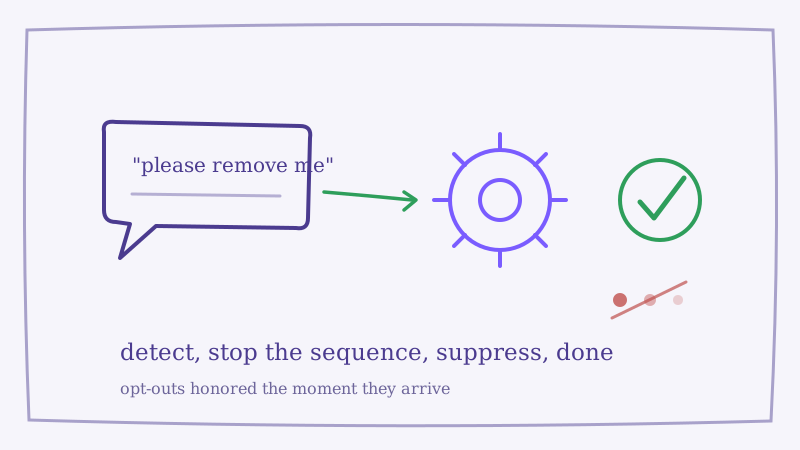
The point of an AI reply agent here is not to argue with the opt-out, it is to process it instantly and correctly. A sound configuration does four things the moment a reply arrives:
- Classify intent reliably. It recognizes both explicit (“unsubscribe”) and implicit (“not interested, please remove me”) opt-outs, and crucially, it does not try to “save” them with a counter-pitch.
- Stop the sequence immediately. The contact is removed from every active and scheduled touch, so no further automated email goes out. This is the step manual inboxes miss most.
- Suppress durably and acknowledge politely. The address is flagged so future campaigns respect it, and the agent can send a short, courteous confirmation rather than silence, which itself reduces complaints.
- Escalate the ambiguous ones. A reply that might be an opt-out but reads more like a soft objection gets routed to a human instead of guessed at, because over-suppressing a real lead and under-suppressing an opt-out are both mistakes worth avoiding.
The combination matters: detection without sequence-stopping still sends the offending email, and stopping without durable suppression just delays the problem to the next campaign.
Compliance and clean data reinforce each other
Honoring opt-outs is a legal obligation, but it is also good list hygiene, and the two goals point the same direction. An address that opts out should be suppressed, and an address that hard-bounces or turns out to be invalid should never have been mailed in the first place. The cleanest outbound programs handle both ends: they validate the list before sending so they are not burning sends and reputation on bad addresses (the job tools like Scrubby do up front), and they suppress opt-outs the instant they arrive on the reply side. One keeps you out of the spam folder, the other keeps you out of trouble, and a fast AI reply agent is what makes the second one reliable instead of dependent on someone remembering to check the inbox.
The takeaway
Booking meetings is the headline feature of an AI reply agent. Quietly and correctly processing the replies that say “stop” is the one that protects your sender reputation and keeps you compliant. Configure the agent to recognize opt-outs generously, stop sequences immediately, suppress durably, and escalate the gray areas, and you turn the highest-risk reply in your inbox into the one you never have to worry about handling late.