
How AI Reply Agents Handle ‘I Need to Run This By My Team’ Replies
There is a specific kind of cold email reply that looks like progress but usually ends in silence. The prospect writes back something warm and reasonable: “This looks interesting, but I need to run it by my team before we go any further.” Most senders read that as a win, fire off a cheerful “sounds great, let me know!” and then wait. And wait. The thread goes quiet, the follow-up feels pushy, and a genuinely interested lead evaporates into the fog of someone else’s internal meeting.
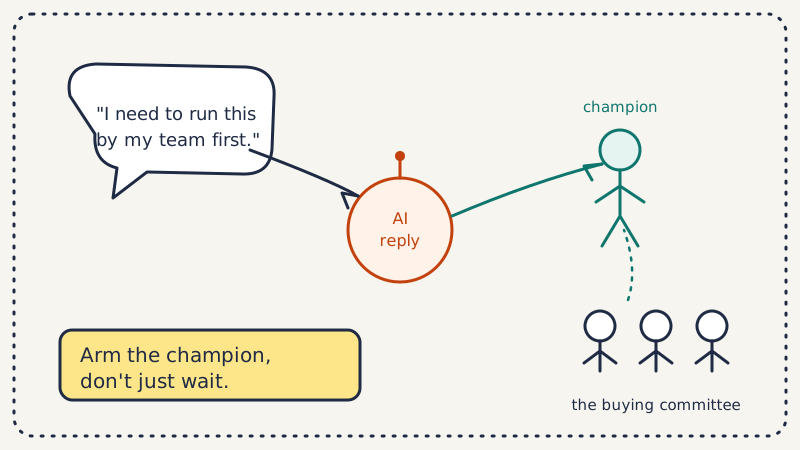
The mistake is treating “let me run this by my team” as a pause. It is not a pause. It is a handoff. The person replying is telling you they are about to become your salesperson inside their own company, and they are going to do it without you in the room, probably in a three-minute hallway conversation, using whatever they can remember about your product. What happens next depends entirely on how well you arm them in that exact moment. This is one of the highest-leverage replies in all of outbound, and it is also one that a dedicated AI reply agent handles far more reliably than a busy human working through an inbox.
What the reply actually means
When someone says they need to loop in their team, they are almost never asking you to disappear until they resurface. They are signaling three things at once.
First, they have enough interest to spend social capital internally on your behalf. Nobody brings a vendor to their boss or their team unless they think there is at least a chance it is worth it. That is a buying signal, not a brush-off.
Second, they do not have unilateral authority, which means your deal now has a buying committee whether you like it or not. The reply is a quiet introduction to stakeholders you have not met and may never directly email.
Third, and most importantly, the quality of the internal pitch is now out of your hands unless you make it your business to shape it. Your champion will summarize your product in their own words, answer questions they may not know the answers to, and defend a price they have not been coached to justify. If you leave them to do that alone, you are gambling your deal on a secondhand retelling.
The whole game, then, is to enable the champion. You want to make it effortless for them to represent you accurately and persuasively, and you want to do it fast, while the conversation is still warm and before their internal meeting happens.
Why the human default fails here
A human SDR working a full inbox tends to handle this reply in one of two unhelpful ways.
The first is the cheerful non-answer: “Great, let me know what they think!” This does nothing. It hands all the work back to the prospect and adds zero ammunition to their internal case. It also starts an ambiguous waiting period with no agreed next step, which is exactly the condition under which threads die. We wrote about that decay curve in detail in what happens when you wait 24 hours to reply to a cold email lead, and the same physics apply to internal handoffs.
The second failure is over-correction: the rep dumps a wall of attachments, a full deck, a pricing PDF, and a calendar link all at once, overwhelming a champion who just needed one clean paragraph they could forward. Neither response is calibrated to what the moment actually calls for, which is a short, forwardable, confidence-building message plus a concrete next step.
The reason humans miss the calibration is not incompetence, it is bandwidth and timing. The reply lands at 4:47pm on a Thursday, the rep is heads-down on three other deals, and by the time they get to it the internal meeting has already come and gone. Timing is the whole thing here, and timing is precisely where automated reply handling has the structural advantage. If your team is already drowning in responses, the pattern we described in when inbound reply volume outpaces SDR capacity is the same force that lets these high-value handoffs slip.
How an AI reply agent handles it
A dedicated reply agent reads the incoming message, recognizes the internal-buy-in pattern specifically (as distinct from a stall, an objection, or a brush-off), and responds within minutes with a message engineered to travel. Here is what that response is actually doing under the hood.
It equips the champion with a forwardable summary. Instead of “let me know,” the agent replies with a tight, self-contained paragraph the prospect can literally copy into a Slack message or forward to their team: what the product does, the one outcome that matters most to their situation, and the single strongest proof point. The champion no longer has to reconstruct your pitch from memory. You wrote it for them.
It answers the questions their team will ask before they are asked. A good reply agent anticipates the two or three objections a buying committee predictably raises (cost, implementation effort, and “do we really need this”) and pre-loads the champion with crisp answers. That way, when someone in the meeting pushes back, your champion is not caught flat-footed. This is the same anticipatory logic a strong rep uses on a pricing pushback, which we broke down in how AI reply agents handle pricing questions without killing the deal.
It offers to join the room, gently. The single best outcome of a “run it by my team” reply is getting invited to the internal conversation instead of being summarized in absentia. The agent proposes a short group call or offers to send a two-minute async walkthrough the champion can play for the team, and it does so without being pushy. When the prospect says yes, the agent can hand the thread straight into a booking flow like Kali so the meeting gets on the calendar before the momentum fades.
It sets a concrete, low-pressure next step with a real date. Rather than an open-ended “let me know,” it anchors to something specific: “Happy to send a short summary you can share with the team, and I will check back Tuesday to see if any questions came up.” That gives the thread a heartbeat and a reason to reopen that does not feel like nagging.
It never forgets to follow up. This is where automation quietly wins. A human forgets the Tuesday check-in because forty other things happened. The agent does not. It tracks the commitment and re-engages on schedule, in context, referencing the exact internal conversation the prospect mentioned.
The message pattern that works
Under the hood, the agent is composing to a repeatable shape. A strong response to “I need to run this by my team” tends to hit these beats in order:
- Affirm and lower the stakes. Make it easy to say yes to bringing you in, and make it clear you are trying to make their internal pitch easier, not add work.
- Hand over the forwardable paragraph. One clean block, written to be copied, focused on the outcome their team cares about rather than a feature list.
- Pre-empt the obvious objections. Two or three sentences that answer the cost, effort, and necessity questions before the committee raises them.
- Propose a specific next step with a date. A group call, an async walkthrough, or a scheduled check-in, never an open-ended wait.
That structure respects the champion’s time, arms them for a conversation you cannot attend, and keeps the deal on a clock. It is the difference between hoping the internal meeting goes well and actively shaping how it goes.
Where this fits in the bigger picture
Handling the internal-buy-in reply well is one instance of a larger truth about outbound: the money is made in the reply, not the send. Getting a warm response is only the start of the real work, and most of that work is about speed, judgment, and never dropping a thread. The teams that win are the ones that treat every reply as a live conversation to be advanced, not a task to be triaged. That is the same reason fast, consistent answers move the numbers so much, which we covered in how five minute response times increase conversions.
An AI reply agent is built specifically for this layer. It is not a sending tool and it is not a warm-up service. It reads real replies, understands the intent behind messages like “let me run this by my team,” and responds in your brand voice fast enough to matter, escalating to you only when a thread genuinely needs a human. For the internal-buy-in reply in particular, that combination of speed and calibrated content is exactly what turns a lukewarm handoff into a champion who sells for you. And because it works cleanly, it pairs naturally with a validated, deliverable list from a tool like Scrubby so the replies you are working this hard to convert are landing in real inboxes in the first place.
The takeaway
“I need to run this by my team” is not the sound of a deal slowing down. It is the sound of a deal changing hands, from you to an internal champion who is about to pitch you without your help. Waiting politely is how you lose those deals. Arming the champion, fast, with a forwardable summary and a concrete next step is how you win them.
That is precisely the moment a dedicated reply agent is built for: it recognizes the handoff, responds in minutes, and equips the person on the other end to sell you well in a room you will never see. You can see how that reply layer works at underfive.ai.