
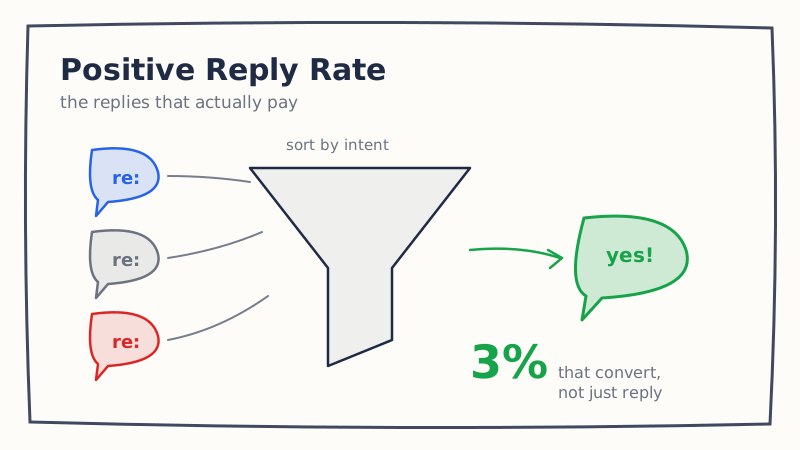
Your cold email reply rate says 9 percent and your VP is happy, but the pipeline report tells a different story: almost no new meetings. The number on the dashboard and the number that pays rent have quietly drifted apart. The metric that reconnects them is positive reply rate, and most teams do not track it.
Reply rate counts every human who wrote back. Positive reply rate counts only the ones who wrote back with interest. Those are very different populations, and the gap between them is where deals are won or lost. This guide defines positive reply rate, shows you how to calculate it from data you already have, and walks through the levers that actually move it.
What Positive Reply Rate Actually Measures
Positive reply rate is the percentage of delivered cold emails that earn a response signaling genuine interest or forward motion. Not “leave me alone.” Not “wrong person.” Not an out-of-office bounce dressed up as a reply. A positive reply is one that opens a door: a question about pricing, a request for a demo, a “sounds interesting, tell me more,” or a referral to the right buyer.
The formula is simple:
Positive reply rate = (positive replies / delivered emails) × 100
The hard part is not the math. It is deciding, honestly, what counts as positive. Total reply rate is easy to inflate because it rewards any response at all, including the ones actively telling you no. A campaign that provokes 40 “unsubscribe” replies and 40 “not interested” replies has a reply rate that looks busy and a positive reply rate near zero. That is the trap. The vanity number goes up while the revenue number stays flat.
Why Total Reply Rate Misleads You
Picture two campaigns, each sending 1,000 delivered emails.
Campaign A gets 90 replies for a 9 percent reply rate. Break those replies open and you find 55 unsubscribes and hard nos, 25 “wrong person” or “no budget” deflections, and 10 that show real interest. Positive reply rate: 1 percent.
Campaign B gets 50 replies for a 5 percent reply rate, which looks worse on paper. But 30 of those are interested prospects asking to talk. Positive reply rate: 3 percent.
Campaign B has half the reply rate and three times the pipeline. If you optimized on total reply rate, you would double down on A and quietly kill the campaign that was actually working. This is not a hypothetical edge case. Aggressive subject lines and provocative hooks reliably lift total replies while lowering the quality of those replies, because irritation is a response too. Positive reply rate is the metric that refuses to be fooled by volume.
For a grounded view of what total reply rates look like across sectors before you filter for quality, our cold email reply rate benchmarks by industry give you the baseline. Positive reply rate is the layer you build on top of it.
How to Classify a Reply as Positive
You cannot measure what you refuse to define, so draw a clean line. A workable classification bucket for cold email replies looks like this:
Positive (counts toward the metric):
- Explicit interest: “yes, let’s talk,” “send me a time,” “what does pricing look like”
- Soft interest with a real question about the product, use case, or fit
- Referral or forward to the correct decision maker
- “Not now, but reach out in Q3” with a specific future window
Neutral (excluded from positive, worth tracking separately):
- “Wrong person” with no referral
- Vague acknowledgments that ask for nothing
- Auto-replies and out-of-office messages
Negative (excluded):
- Unsubscribe or opt-out requests
- “Not interested,” “stop emailing me,” or a complaint
The judgment calls live in the soft-interest band, and consistency matters more than perfection. Whatever rule you pick, apply it the same way every week so the trend line means something. This is exactly the kind of sorting that our guide on cold email reply categories and triage breaks down in more operational detail. The referral case deserves special mention: a forward to the right buyer is one of the highest-value replies you can get, and teams that dump it in the neutral pile are undercounting their best outcomes.
What Counts as a Good Positive Reply Rate
The honest answer is that it depends on your list quality, offer, and market, so treat any single number with suspicion. A tightly targeted campaign to a warm-ish niche will clear a bar that a broad, sprayed list never will. Rather than chase an absolute benchmark, anchor on two comparisons:
- Your own trend. Is this month’s positive reply rate higher than last month’s on comparable lists? That is the only benchmark you fully control, and it is the one that compounds.
- The ratio of positive to total replies. If most of your replies are positive, your targeting and message are aligned. If positive replies are a thin slice of a fat total, you are attracting attention from the wrong people, and more volume will only amplify the mismatch.
A useful gut check: on a well-targeted B2B campaign, positive replies making up a meaningful share of your total replies is the signal that you are talking to the right accounts. When that ratio collapses, the problem is almost never send volume. It is fit.
The Levers That Actually Move It
Positive reply rate responds to a short list of inputs. Pull these in order.
Targeting first, always. The single biggest driver of positive replies is emailing people for whom your offer is genuinely relevant. A better list beats a better subject line every time. Tighten your ICP, cut the tangential titles, and remove accounts that have no plausible reason to buy. You will send fewer emails and get more of the replies that matter.
Match the offer to the reader’s problem. Positive replies come from prospects who see themselves in the first two lines. Lead with the specific pain your product removes, not your feature list. Personalization by segment, not just first name, lifts the quality of who bothers to respond. Our breakdown of personalizing reply sequences by prospect industry covers how far this can go.
Make the ask small and clear. A positive reply is often just a reader taking the path of least resistance. “Worth a quick look?” earns more genuine yeses than “Do you have 30 minutes Thursday for a full demo.” Lower the activation energy of the first reply and you convert curiosity that a heavier ask would have scared off.
Protect the replies you earn. This is the leak most teams never see. A prospect writes back interested on a Tuesday afternoon and hears nothing until Thursday morning, by which time the moment has cooled. Speed of handling does not change how many positive replies you generate, but it decides how many survive into a booked meeting. The economics of that lag are laid out in how SDR handoff delays kill cold email conversions.
That last lever is where measurement turns into money, and it is where most manual workflows quietly bleed pipeline.
From Positive Reply to Booked Meeting
A positive reply rate is only worth improving if you convert those replies before they go cold. This is the operational reality that pure benchmark posts skip: the metric is a leading indicator, and the lag between reply and response is the tax you pay on every point you earn.
An AI reply agent from Underfive reads each incoming reply, classifies it by intent the same way you would sort it by hand, and responds in the prospect’s window instead of yours. The interested ones get an immediate, relevant answer and a path to the calendar. The nos and unsubscribes are handled cleanly so your positive replies are never buried under noise. Because the system tags every reply by intent, it also produces the classification data that makes positive reply rate measurable in the first place, instead of forcing you to reverse-engineer it from a messy inbox. You can see how the reply classification and routing works if you want the mechanics.
If you are already tracking outcomes, fold positive reply rate into the same view as your downstream numbers. Our guide to measuring AI reply agent ROI shows where it sits between reply volume and closed revenue.
Start Measuring It This Week
You do not need new software to begin. Pull your last month of cold email replies, sort each one into positive, neutral, or negative using the buckets above, and divide positive replies by delivered emails. That single number tells you more about the health of your outreach than any reply rate ever will. Track it for a few weeks, watch which changes move it, and let the campaigns with a strong positive reply rate get the budget, no matter how their vanity metrics look.
The teams that win at cold email in 2026 are not the ones sending the most or even getting the most replies. They are the ones who know exactly which replies are worth answering, and answer them fast.