Cold Email Reply Rates by Industry: 2026 Benchmarks
Almost every cold email post you read quotes a single magic number. “A good reply rate is 5%.” “Top performers hit 10%.” The problem is that those numbers are averages stretched across wildly different industries, list qualities, and offers. A 4% reply rate can be excellent in one vertical and disappointing in another.
This guide breaks down realistic cold email reply rate benchmarks across six common B2B industries for 2026, explains the factors that actually move the number, and shows what separates teams who drown in replies from teams who convert them.
How to read a reply rate benchmark
Before the numbers, three definitions, because half of all reply rate arguments are really definition arguments.
- Reply rate here means the percentage of delivered emails that get any human response, positive or negative. It is not the open rate, and it is not the positive reply rate.
- Delivered matters. If 30% of your sends never reach the inbox, your “reply rate” is quietly measuring a smaller pool than you think. This is why list hygiene sits underneath every benchmark on this page.
- Per prospect, not per email. A healthy sequence of three to four touches will pull replies across the whole sequence. Measuring reply rate on the first email alone understates your real performance.
With that settled, here is what good looks like in 2026.
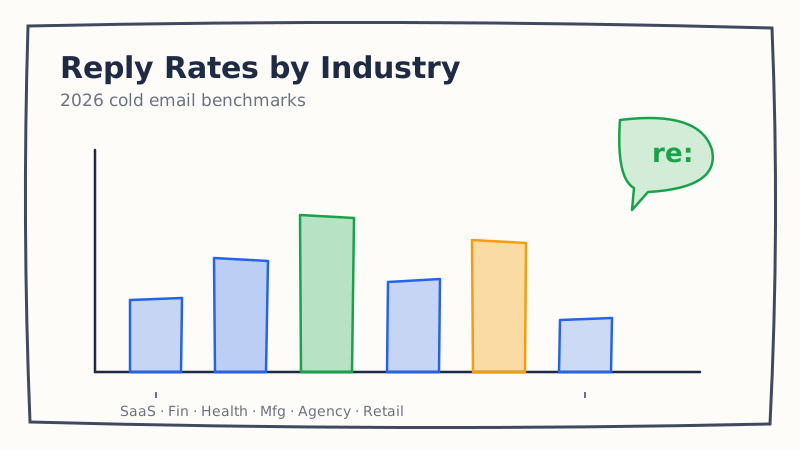
2026 cold email reply rate benchmarks by industry
These ranges reflect well targeted lists, verified contacts, and a three to four email sequence. “Strong” is roughly the top quartile of what disciplined teams achieve, not a theoretical ceiling.
| Industry | Average reply rate | Strong reply rate | Notes |
|---|---|---|---|
| SaaS and software | 3% to 5% | 8% to 10% | Crowded inboxes, but buyers expect email and respond to sharp relevance. |
| Financial services | 2% to 4% | 6% to 8% | Heavily gatekept and compliance sensitive, so specificity wins. |
| Healthcare and life sciences | 4% to 6% | 9% to 11% | Lower send volume per inbox means a relevant message stands out. |
| Manufacturing and industrial | 4% to 7% | 10% to 12% | Less saturated channel, longer consideration, replies skew practical. |
| Marketing and agencies | 2% to 4% | 5% to 7% | The most saturated audience in B2B, so differentiation is everything. |
| Retail and ecommerce | 3% to 5% | 7% to 9% | Seasonal swings are large, timing the send matters more than usual. |
A few patterns are worth calling out. The least saturated inboxes (manufacturing, healthcare) reward relevance with the highest reply rates. The most saturated (agencies, SaaS) force you to earn the reply with sharper targeting. And every single range assumes the email actually got delivered, which brings us to the factors that move these numbers.
The four factors that move your reply rate
Industry sets the baseline. These four levers decide where inside the range you land.
1. List quality and deliverability
This is the factor teams underestimate most. If a meaningful slice of your list is invalid, your emails bounce, your sender reputation drops, and your genuinely good prospects start landing in spam. The reply rate you see is then a fraction of the reply rate you could have had.
Cleaning your list before a campaign is the cheapest reply rate improvement available. Running addresses through a validation tool like Scrubby before you send removes the bounces that quietly drag down both deliverability and your denominator. A verified list does not just protect your domain, it makes every other optimization on this list actually count.
2. Targeting and relevance
A 2% reply rate on a precise list of 200 beats a 0.5% reply rate on a sloppy list of 2,000, and it does it without burning your domain. Narrow your audience until the first line of the email could only have been written to that person. Reply rates climb fastest when the prospect cannot tell whether you sent the message to one person or one thousand.
3. Sequence length and timing
Most replies do not come from email one. A disciplined three to four touch sequence, spaced sensibly, typically doubles the reply rate of a single send. The mistake is stopping at two, or sending all four in a week. Patience and spacing are free, and they compound.
4. Speed and quality of your follow-up
Here is the factor that the benchmark tables never show, because it happens after the reply lands. A strong reply rate is worthless if you answer interested prospects eight hours later with a generic reply. Conversion happens in the response, not the send.
A high reply rate is a capacity problem, not a finish line
Teams obsess over lifting reply rates and then get buried by the consequence of succeeding. Double your reply rate and you double the inbound your reps have to read, qualify, and answer. The first reply often arrives within minutes, and prospects who get a fast, relevant response convert at a much higher rate than those left waiting.
This is exactly where an AI reply agent earns its place in the stack. Instead of a rep manually triaging every reply, the inbox agents in Underfive’s Unified Inbox read each incoming response, understand intent, answer in your brand voice, handle the common objections, and book the meeting, around the clock. The reply rate work gets the prospect to raise their hand. The inbox agents make sure no raised hand goes cold.
And once a positive reply turns into a meeting, the booking itself should be just as fast. Pairing reply handling with calendar automation through a tool like Kali closes the loop from interested reply to confirmed slot without a human bottleneck.
How to use these benchmarks
- Find your industry row and compare it to your last campaign’s true reply rate, measured per prospect on delivered emails.
- If you are below average, audit deliverability first. A clean, verified list usually explains the gap before copy ever does.
- If you are at average, push on targeting and sequence length to reach for the strong column.
- If you are already strong, stop optimizing the send and start optimizing the response. Your bottleneck has moved from getting replies to handling them well and fast.
Benchmarks are a mirror, not a target. The number that actually grows your pipeline is not the reply rate, it is the percentage of those replies that turn into booked meetings. Get the list clean, get the targeting sharp, and make sure every reply gets a fast, human quality answer. Do that and you will quietly beat the benchmark for your industry, then wonder why you ever worried about the average in the first place.