Why Generic Reply Sequences Are Killing Your Conversion Rates
Here is the hard truth: if your AI reply sequences treat every prospect the same way, you are leaving deals on the table. A SaaS founder and a real estate broker have wildly different pain points, buying timelines, and communication preferences. Sending them identical follow-ups is like wearing the same outfit to a beach party and a board meeting.
The fix is not complicated. You just need to teach your AI reply agent to adjust its tone, timing, and talking points based on the prospect’s industry. In this guide, we will walk through exactly how to do that — step by step — so your sequences feel personal without requiring you to manually write every email.
The Case for Industry-Specific Personalization
Let’s look at the numbers. According to multiple studies on cold outreach effectiveness:
- Personalized emails get 26% higher open rates compared to generic blasts
- Industry-relevant messaging increases reply rates by 30-50% over one-size-fits-all templates
- Prospects who receive tailored follow-ups convert 3x faster through the sales pipeline
The reason is simple. When someone reads an email that references their specific challenges, uses their industry’s language, and acknowledges their typical workflow, it signals that you actually understand their world. That trust shortcut is everything in outbound sales.
Step 1: Map Your Target Industries Into Segments
Before you touch any AI settings, you need to define your industry segments clearly. Most teams try to personalize for too many verticals at once and end up with watered-down messaging that helps nobody.
Start with 3-5 industries where you have the strongest product-market fit. For each one, document:
- Core pain points — What keeps them up at night?
- Buying triggers — What events push them to look for solutions?
- Decision-making style — Do they move fast or need consensus?
- Language preferences — Formal or casual? Technical or plain?
- Typical sales cycle length — Days, weeks, or months?
Here is a quick example framework:
| Industry | Pain Point | Buying Trigger | Tone | Cycle |
|---|---|---|---|---|
| SaaS | Churn, onboarding friction | Funding round, new hire wave | Casual, data-driven | 2-4 weeks |
| Real Estate | Lead quality, follow-up speed | Market shift, new listing season | Direct, urgent | 1-2 weeks |
| Healthcare | Compliance, patient communication | Regulation changes, expansion | Formal, trust-focused | 4-8 weeks |
| E-commerce | Cart abandonment, ad spend ROI | Seasonal peaks, platform migration | Energetic, ROI-focused | 1-3 weeks |
| Financial Services | Risk management, client retention | Market volatility, new regulations | Conservative, precise | 6-12 weeks |
Step 2: Build Industry-Specific Reply Templates
Now comes the fun part. For each industry segment, you want to create a set of reply templates that your AI agent can draw from. These are not rigid scripts. They are more like guardrails that keep the AI’s responses relevant.
For SaaS prospects, your templates might look like this:
Hey — saw you just closed your Series A. Congrats. Quick question: as you scale the team, how are you handling [specific pain point]? We helped [similar company] cut that process in half. Happy to share the playbook if it is useful.
For real estate prospects, shift the energy:
Hi — noticed your team listed 40+ properties last month. That is serious volume. Are your agents still manually following up with every lead that comes in? Most brokerages we work with automate that piece and reclaim 10+ hours per week. Worth a quick look?
For healthcare prospects, dial up the trust signals:
Hello — I understand compliance is always top of mind for organizations like yours. We have been working with several healthcare groups to streamline their patient outreach while staying fully within HIPAA guidelines. Would it be helpful if I shared a brief case study?
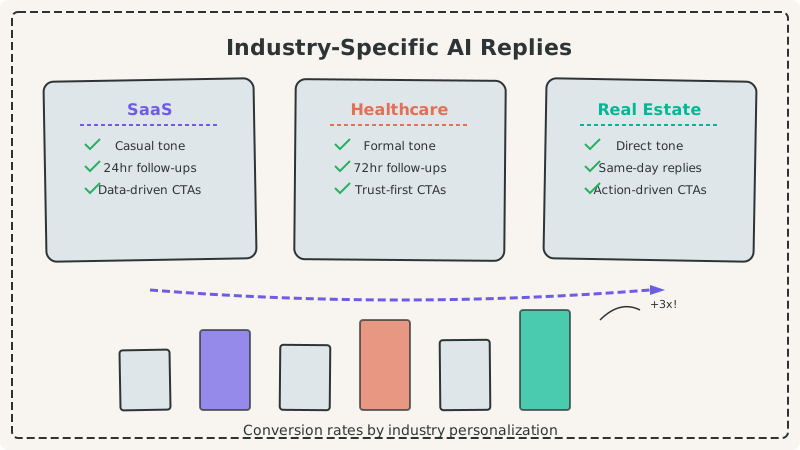
Notice how each template adjusts not just the words but the entire energy of the message. The SaaS version is casual and founder-to-founder. The real estate one is action-oriented and numbers-driven. The healthcare template leads with compliance and trust.
Step 3: Configure Your AI Agent for Industry Detection
This is where your tech stack matters. Tools like Kali can help you build intelligent reply sequences that adapt based on prospect data. The key is feeding your AI agent the right signals so it can identify which industry a prospect belongs to and select the appropriate template framework.
Here are the signals your AI should look for:
- Company domain and website content — Industry keywords on their site
- Job title patterns — “Broker” vs “CTO” vs “Practice Manager”
- LinkedIn company category — Often the most reliable signal
- CRM tags and custom fields — Data your team has already enriched
- Email signature clues — Licensing numbers, certifications, office types
Once your agent can reliably detect the industry, you set up conditional logic:
IF prospect.industry = "real_estate" THEN
  use template_set: real_estate_sequences
  set reply_timing: aggressive (24hr gaps)
  set tone: direct_urgent
  set max_touches: 5

IF prospect.industry = "healthcare" THEN
  use template_set: healthcare_sequences
  set reply_timing: patient (72hr gaps)
  set tone: formal_trust
  set max_touches: 7
Step 4: Adjust Timing and Cadence by Industry
This is the piece most people miss entirely. Personalization is not just about what you say — it is also about when you say it.
Fast-moving industries (real estate, e-commerce, recruiting):
- First reply: Same day or within 4 hours
- Follow-up gaps: 24-48 hours
- Total sequence length: 7-10 days
- Number of touches: 4-5
Medium-paced industries (SaaS, marketing agencies, consulting):
- First reply: Within 24 hours
- Follow-up gaps: 2-3 days
- Total sequence length: 14-21 days
- Number of touches: 5-7
Slow-moving industries (healthcare, financial services, enterprise):
- First reply: Within 24 hours
- Follow-up gaps: 3-5 days
- Total sequence length: 30-45 days
- Number of touches: 7-10
The logic here is straightforward. In real estate, if you wait three days to follow up on a lead, that prospect has already talked to five other agents. But in healthcare procurement, sending daily emails will get you flagged as spam and blacklisted from the organization.
Step 5: Use Dynamic Variables Beyond First Name
Basic personalization stopped working years ago. “Hi {first_name}” is table stakes. To truly customize your AI reply sequences by industry, you need deeper dynamic variables.
Here is what to pull in for each industry:
SaaS:
- Recent funding announcements
- Tech stack (from job postings or BuiltWith)
- Team size changes
- Product launch dates
Real Estate:
- Recent listings or sales volume
- Market area and property types
- Brokerage size and growth rate
- Local market conditions
Healthcare:
- Recent expansions or new locations
- Specialization areas
- Patient volume indicators
- Recent regulatory changes affecting them
E-commerce:
- Platform they use (Shopify, WooCommerce, etc.)
- Product category and price range
- Recent promotional activity
- Seasonal relevance
Before plugging these variables into your sequences, make sure your prospect data is clean. Running your lead lists through Scrubby helps you verify email addresses and avoid bouncing messages off invalid contacts. There is nothing worse than crafting the perfect industry-specific sequence only to have it land in a dead inbox.
Step 6: A/B Test Across Industries (Not Just Within Them)
Most sales teams A/B test subject lines or CTAs within a single sequence. That is fine, but you are missing the bigger picture. You should also be testing across industries to discover which personalization levers matter most for each vertical.
Set up your tests like this:
Test 1: Tone Impact
- Version A: Casual tone for financial services prospects
- Version B: Formal tone for financial services prospects
- Measure: Reply rate and meeting conversion
Test 2: Timing Impact
- Version A: 24-hour follow-up gaps for healthcare
- Version B: 72-hour follow-up gaps for healthcare
- Measure: Unsubscribe rate and positive reply rate
Test 3: Content Depth
- Version A: Short, punchy messages for SaaS prospects
- Version B: Detailed, data-rich messages for SaaS prospects
- Measure: Click-through rate and demo bookings
Track everything in your CRM and review the data every two weeks. You will be surprised at what you find. Some industries that you assumed wanted formal outreach might actually respond better to casual messages. The data will tell you.
Step 7: Build an Industry Playbook Your Whole Team Can Use
Once you have tested and refined your industry-specific sequences, document everything. This playbook becomes the foundation for scaling your outreach without losing the personal touch.
Your playbook should include:
- Industry overview — Key characteristics and buying behavior
- Ideal customer profile — Company size, role targets, tech maturity
- Messaging framework — Approved templates, tone guidelines, banned phrases
- Timing rules — Cadence settings and best send times
- Objection handling — Industry-specific concerns and responses
- Success metrics — Benchmarks for open, reply, and conversion rates
- Real examples — Actual sequences that performed well (anonymized)
With a platform like CAM, you can centralize these playbooks and make sure every rep on your team has access to the same industry-tuned sequences. That way, a new hire can hit the ground running with proven messaging instead of reinventing the wheel.
Common Mistakes to Avoid
Mistake 1: Over-personalizing to the point of being creepy. Mentioning someone’s recent vacation photos from LinkedIn is not personalization. It is stalking. Stick to professional signals like company news, role changes, and industry trends.
Mistake 2: Using industry jargon you do not fully understand. If you sell to healthcare and you misuse a clinical term, you instantly lose credibility. Have someone from the industry review your templates before going live.
Mistake 3: Setting it and forgetting it. Industries evolve. What worked for SaaS prospects during a boom market will fall flat during a downturn. Review and refresh your sequences quarterly at minimum.
Mistake 4: Ignoring the “no industry” segment. Some prospects will not fit neatly into your defined segments. Build a solid general sequence as a fallback so these contacts do not slip through the cracks.
Mistake 5: Skipping email validation. Even the best personalization is useless if your emails never reach the inbox. Validate your lists regularly and keep your sender reputation healthy.
Measuring Success: The Metrics That Matter
Track these numbers for each industry segment separately:
- Open rate by industry — Are your subject lines resonating with each vertical?
- Reply rate by industry — Which industries engage most with your messaging?
- Positive reply rate — Not all replies are good. Track sentiment.
- Meeting conversion rate — The metric that actually pays the bills.
- Sequence completion rate — Are prospects engaging early or ghosting until the end?
- Unsubscribe/spam rate — If this spikes for a specific industry, your messaging is off.
Create a simple dashboard that breaks these metrics out by industry. When you spot an underperforming segment, dig into the sequence and figure out what needs adjusting. Maybe the timing is off. Maybe the pain points you are hitting are outdated. Maybe the tone is wrong for that audience.
Putting It All Together
Personalizing AI reply sequences by prospect industry is not about writing hundreds of unique emails. It is about building smart frameworks that let your AI agent adapt its approach based on who it is talking to.
Here is the workflow in a nutshell:
- Segment your top industries and document their characteristics
- Build template sets for each industry with the right tone and content
- Configure your AI agent to detect industries and select the right templates
- Set industry-appropriate timing and cadence rules
- Enrich your dynamic variables beyond basic first-name personalization
- Test across industries and let the data guide your optimizations
- Document everything in a playbook your whole team can access
The teams that nail this consistently see 2-3x improvements in reply rates and significantly shorter sales cycles. The ones that keep blasting generic sequences will keep wondering why their conversion rates are stuck.
Start with your top-performing industry. Get the sequence dialed in. Prove the model works. Then expand to the next vertical. That is how you scale personalized outreach without burning out your team or your AI credits.