
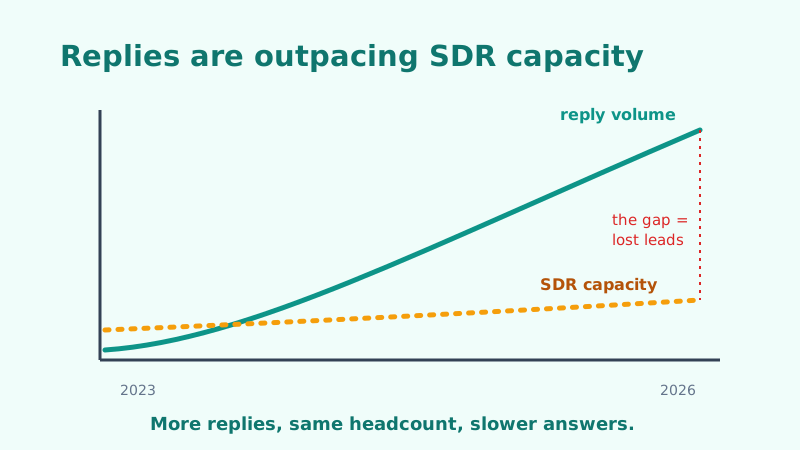
There is a quiet structural problem building inside B2B sales teams in 2026, and most of them have not named it yet. The number of replies coming back from outbound is rising faster than the number of people available to answer them. The send side of outbound got cheaper and more automated every year. The respond side did not. That gap is where pipeline is leaking right now.
Three things happened at once
Outbound volume went up. Sequencing tools, better data, and multichannel cadences mean a single SDR now touches far more prospects per week than they did a few years ago. More touches mean more replies, even if reply rates fell.
AI made sending nearly free. Drafting, personalizing, and scheduling outbound is now mostly automated. A small team can put out the volume that used to require a much larger one. The bottleneck moved off the keyboard.
Reply handling stayed manual. Here is the part nobody scaled. When a prospect replies, a human still reads it, decides what it means, drafts a response, and sends it, usually hours later, often the next day. The send side got a force multiplier. The respond side is still one human, one reply, one inbox at a time.
Multiply those together and you get the gap: volume climbing on a steep curve, capacity climbing on a flat one. The space between the two lines is replies that get a slow answer, a generic answer, or no answer at all.
Why the gap costs more than it looks
A delayed reply is not a neutral event. The data on speed-to-lead has been consistent for years: the odds of converting a lead drop sharply after the first hour, and most replies do not get answered within that window. When a prospect takes the effort to reply and then waits a day for a response, you have not just lost time, you have signaled how responsive you will be as a vendor. The first reply is an audition, and a slow one fails it.
It gets worse during a good week. The moment outbound works, when a campaign lands and replies spike, is exactly the moment a fixed-capacity team falls furthest behind. Success creates the backlog. So the better your top of funnel performs, the more leads you drop at the reply stage, which is a brutal way to cap your own growth.
Why “just hire more SDRs” does not close it
The instinct is to add headcount. Three problems with that.
First, the economics are upside down. You would be hiring people to do a task that is mostly pattern recognition and fast drafting, the kind of work that scales terribly with humans and well with software. You pay linearly for a problem that is growing faster than linearly.
Second, hiring is slow and lumpy. Reply volume spikes the week a campaign hits. You cannot hire and ramp an SDR in a week. By the time the new rep is productive, the spike that justified them has passed and a new one is somewhere else.
Third, even fully staffed, humans cannot hit the response window that matters. A prospect who replies at 9 p.m. or during a team meeting waits regardless of headcount. The conversion-critical first hour does not respect your staffing schedule.
What actually closes the gap
The structural fix is to make reply handling scale the way sending already does. That means letting software handle the first response, qualification, and routing, with humans stepping in where judgment actually adds value, instead of on every single reply.
Concretely, the high-leverage move is automating the first touch back. When a reply comes in, an AI reply agent can read it, answer the straightforward cases immediately in your brand voice, qualify intent, and hand the genuinely complex ones to a human with context already attached. The point is not to remove people from the loop. It is to stop spending human hours on the eighty percent of replies that are routine, so the team has capacity for the twenty percent that need them. This is the entire reason a tool like Underfive exists: closing the gap between reply volume and human capacity by handling the first response instantly instead of hours later.
A few things make this work in practice:
- Answer in minutes, not hours. The first hour is the whole game, so the first reply should land in minutes regardless of time of day.
- Qualify before you route. Not every reply deserves an SDR’s time. Sorting interested from not-interested from out-of-office before a human ever looks is most of the leverage.
- Keep the handoff clean. When a human does take over, they should inherit the full context, not start cold.
The upstream half of the problem
Worth naming: part of the reply gap is self-inflicted by bad data. A meaningful slice of “replies” are bounces, auto-responders, and out-of-office noise that a tired SDR still has to triage. Cleaning the list before send with a validation layer like Scrubby cuts that noise at the source, so the replies that reach your team are mostly real humans worth answering. Fewer junk replies means the capacity you do have goes to actual prospects.
Where this goes
The teams pulling ahead in 2026 are not the ones sending the most. Sending is solved. They are the ones who fixed the respond side, so that a spike in replies is a good day instead of a backlog. The gap between volume and capacity is not going to close on its own, because the forces widening it, cheaper sending and smarter automation on the outbound side, are only accelerating. The question for every sales team this year is simple: when outbound works, can you actually answer everyone who replies? Right now, for most teams, the honest answer is no. That is the gap to close.