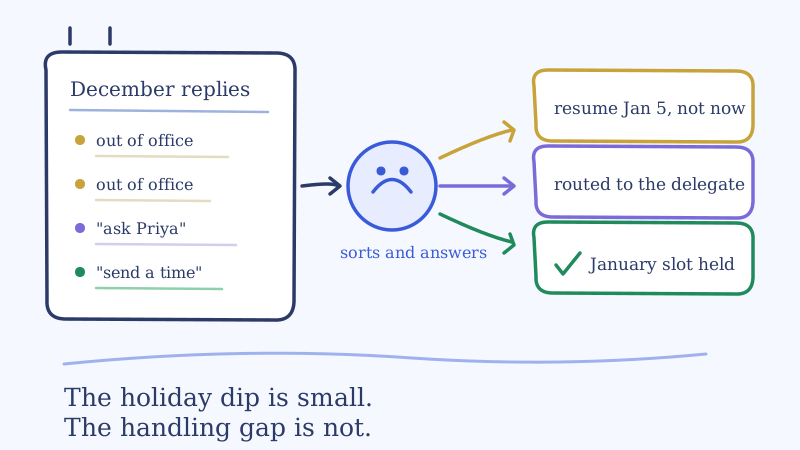
Every year around now, someone on your team asks whether to pause outbound for the holidays, and the answer gets made on vibes. The real question is not whether cold outreach during the holidays works. It is whether your team can handle the specific kind of replies December produces, because that is where the pipeline actually leaks.
Most posts on this topic give you a seasonality stat and tell you to personalize more. That advice is not wrong, it is just aimed at the wrong half of the problem. Sending is the easy part in December. Answering is the part that quietly falls apart.
What the data actually says about December cold email reply rates
Two credible datasets disagree about the size of the holiday dip, and the disagreement is more useful than either number alone.
Belkins analyzed 7.5 million cold emails sent across their client campaigns in 2025. Reply rates peaked in February at 0.54% and bottomed out in December at 0.35%, with the second half of the year averaging 0.40% against the first half’s 0.50%.
Hunter looked at a wider panel, 14,500 senders and 86,000 sender-months from 2021 through 2025, and found November and December came in below normal in four of the last five years by about 5%.
A 35% relative decline and a 5% decline are not the same story. The most likely reconciliation is population, not measurement error. Belkins measures agency-run campaigns, which skew toward high volume and similar playbooks executed at scale. Hunter measures a broad mix of senders, including low-volume and highly targeted ones. Read together, they suggest the December drop is concentrated in commodity outbound rather than being a law of physics that applies to every sender. If your campaigns look like everyone else’s, expect the steeper number. If they are narrow and specific, expect closer to the shallow one.
Then there is the question of what a 0.19 percentage point drop means operationally. On 2,000 sends, moving from 0.54% to 0.35% is the difference between roughly 11 replies and roughly 7. Four replies. That is a rounding error against the number of warm replies a typical team lets go cold over a two week stretch when half the inbox owners are on PTO. The seasonality everyone argues about is smaller than the handling failure nobody measures.
The holiday reply mix changes shape, and that is the actual problem
Reply rate is a volume metric. It tells you nothing about composition. In the last three weeks of December, the composition of your inbox shifts hard, and each new category needs a different action than it does in March.
| Reply type | What it looks like in December | The handling error |
|---|---|---|
| Out of office | Spikes to a large share of all replies | Counted as a reply, sequence stops |
| Dated deferral | ”Circle back in January” | Treated as a brush-off to overcome |
| Delegation | ”Reach out to Priya, I’m off until the 5th” | Buried in an auto-reply nobody reads |
| Genuine interest | Lower volume, higher intent | Waits days because the owner is away |
Out of office replies are not replies, but your sequencer thinks they are
This is the most expensive mechanical problem in holiday outbound and almost nobody accounts for it. Most sequencers stop a sequence when a contact replies. An out of office auto-responder is a reply. So in late December your tooling does two things at once: it inflates your reply rate with messages that contain no human intent, and it silently pulls engaged prospects out of your follow-up sequence before they ever read you.
You get a reply-rate chart that looks acceptable and a pipeline that is emptier than the chart implies. If you only fix one thing before the holidays, make it this: confirm your platform’s auto-reply detection is on, and that detected out of office messages resume the sequence after the stated return date rather than ending it. Where that setting lives differs by sequencer, so it is worth checking against the setup notes for your specific tool before December. We went through the mechanics of this in handling out of office replies and timing the follow-up.
The second thing worth knowing is that holiday auto-replies are unusually rich. People who are off for two weeks, rather than a Tuesday afternoon, tend to write a real delegate name and a real return date into the auto-reply. That is a routing instruction and a scheduling instruction handed to you for free. In a manual inbox, it sits unread in a folder of noise. Treated properly, a delegate name is a live referral into the same account, which is the same move as routing a wrong-person reply to the actual decision maker.
”Circle back in January” is usually true in December
For most of the year, a timing deferral is a soft no wearing a polite hat. In the last two weeks of December it is frequently literal. The person does not have budget authority this week, their stakeholders are gone, and nothing can be decided until people come back.
The error is handling it like an objection. Pushing against a real constraint reads as tone deaf and costs you the goodwill you just earned. The correct move is to accept it and make it concrete in the same message: confirm the specific week, propose a dated slot, and get it on a calendar while the context of your original email is still fresh in their head. A deferral with a date on it is pipeline. A deferral without one is a lead you will rediscover in March and have to warm up from scratch. Our fuller take on this pattern is in how to handle not right now and circle back later replies.
The interested replies are fewer and worth more
Here is the part that argues for not pausing. Inbox competition falls in late December because a meaningful share of senders pause for exactly the reasons this post is interrogating. Fewer competing emails means a higher share of attention for the ones that land. And the person who replies with genuine interest on December 22nd, while their calendar is empty and their inbox is quiet, is self-selecting as someone with real motivation rather than someone responding on autopilot.
Those replies are also the ones most likely to rot. They arrive in a window when your reps are off, your coverage is thin, and nobody is watching the shared inbox closely. A high-intent reply that waits four days gets the same outcome as a reply you never got, which is the argument we made with the numbers in how 5-minute response times increase conversions.
A Q4 plan that turns December replies into Q1 pipeline
- Audit auto-reply handling first. Before you touch copy or volume, verify that out of office detection is enabled and that it pauses and resumes the sequence rather than terminating it. This is a settings check that takes ten minutes and protects the whole quarter.
- Cut volume, raise specificity. If the steeper seasonality number applies to generic campaigns, the defense is to not run a generic campaign. Narrow the list, drop the sends per day, and write to a situation rather than a persona.
- Change the ask, not the pitch. A demo request competes with a holiday calendar and loses. An ask for a dated January slot competes with nothing, because the prospect’s January is empty and they know it. Same intent, far lower friction.
- Mine delegate names out of auto-replies. Treat every holiday out of office as a potential warm handoff inside the account. Log the delegate, log the return date, and route accordingly.
- Decide coverage explicitly. Name who owns the inbox on each day between December 20 and January 2. If the honest answer for several of those days is nobody, that is the gap to close, and it is a staffing or automation decision rather than a messaging one.
- Put every deferral on a dated calendar hold. Not a task, not a note. A specific date agreed in the thread, so January starts with booked meetings instead of a re-engagement project.
So should you pause cold outreach during the holidays?
Pause the things that depend on a human being present to work: high-touch sequences aimed at accounts you cannot afford to handle sloppily, and any campaign whose value comes from a fast multi-turn conversation you will not be around to have.
Keep running the things that benefit from a quiet inbox and do not need instant human attention: narrow, specific first touches with a low-friction dated ask, and re-engagement of threads that went quiet earlier in the year, where the end of the year is a natural and non-pushy reason to write again.
The pause-or-send framing is a false binary anyway. The decision that matters is coverage. A team that keeps sending with nobody watching the inbox does worse than a team that pauses cleanly. A team that keeps sending with reliable reply coverage does better than both, because it collects January commitments while competitors are dark. This is the same capacity question we looked at in what happens when inbound reply volume outpaces SDR capacity, just compressed into two weeks and made worse by PTO.
Coverage is the specific reason teams use an AI reply agent over the holidays. Not to replace the conversations your reps want to have, but so that a high-intent reply arriving on December 27th gets a useful answer and a calendar link that day instead of on January 5th. You can see how the escalation and handoff rules work on the Underfive features page, including how to set the boundary between what gets answered automatically and what waits for the human who owns the account.
The next step worth taking this week
Pull the replies your team received between December 20 and January 2 last year. Sort them into the four categories in the table above, and for each one write down how long it waited for a human answer.
Most teams who do this find the same two things. The out of office count is far higher than they assumed, and the handful of genuinely interested replies waited the longest of any replies all year. Those two facts tell you exactly what to fix before December, and neither fix is a better subject line.