How AI Reply Agents Handle Out-of-Office Emails Without Missing Follow-Ups
You send a cold email on Monday. Tuesday morning, you get a reply. Your heart rate ticks up — someone engaged.
Then you read it: “Thanks for your email. I’m currently out of the office until April 21st with limited access to email. For urgent matters, please contact Sarah Chen at [email protected].”
No big deal, right? Except your sequence doesn’t know that. Step 2 fires on Wednesday. Step 3 on Friday. Step 4 the following Tuesday — the day after they return. Your prospect opens their inbox to four messages from the same sender, stacked on top of each other, increasingly urgent in tone. They don’t think “persistent.” They think “spam.”
One click of the spam button, and your sender domain takes the hit. Multiply that by every OOO reply across your team’s campaigns, and you’re looking at a deliverability crisis that compounds monthly.
Why OOO Handling Matters More Than Teams Realize
Most sales teams treat out-of-office replies as a minor inconvenience. The SDR sees the OOO, mentally notes the return date, maybe sets a reminder in their calendar. Maybe.
Here’s what actually happens at scale:
The math is brutal. If you’re sending 500 cold emails a week, roughly 8-15% of recipients are out of office at any given time. That’s 40-75 OOO replies per week. Each one needs to be read, parsed for a return date, matched to the right sequence, paused, and rescheduled. Manually, that’s 2-3 minutes per reply — over two hours of pure admin work every week for a single SDR.
The failure modes are expensive. When a sequence fires into an OOO period, three bad things happen simultaneously:
-
Deliverability damage. Auto-replies generate bouncebacks that email providers track. Too many, and your sender score drops. Pair this with prospects marking your stacked follow-ups as spam, and you’re in trouble. Use Scrubby to validate your lists before sending and you’ll reduce bounces, but you still need to handle the OOO replies that make it through.
-
Lost deals. That prospect was interested enough to have their auto-reply configured (meaning they’re a real person at a real company who reads email). But they come back to a cluttered inbox and your four messages signal desperation, not professionalism. The deal is dead before it started.
-
Wasted send volume. Every email sent during an OOO period is a wasted touch. If you’re running cold outreach at volume, you have finite sends per day per mailbox. Burning them on people who literally cannot read the message is throwing away pipeline capacity.
What AI Reply Agents Actually Detect
Basic keyword matching can spot “out of office” in a subject line. But real OOO handling requires understanding context. A Unified Inbox with AI inbox agents like Underfive classifies OOO responses across multiple dimensions:
Return Date Extraction
The most critical piece of data in any OOO reply. AI parses natural language dates in every format:
- “Back on April 21st” — straightforward
- “Returning the week of the 14th” — fuzzy, needs interpretation
- “Out until after Easter” — holiday-relative, needs calendar awareness
- “Limited access through end of month” — partial availability, different handling
- No date given — indefinite, requires a different follow-up strategy entirely
Underfive doesn’t just find the date. It calculates the optimal re-engagement window — typically 1-2 business days after the stated return, giving the prospect time to clear their inbox backlog before your follow-up lands.
Referral Detection
Some OOO replies hand you a gift: “Please contact [colleague name] at [email] for anything urgent.”
A dumb system ignores this. A smart AI reply agent recognizes this as a potential warm introduction path. Underfive flags these referrals so your team can decide whether to reach out to the alternate contact with an adjusted message — “Your colleague [name] suggested I get in touch while they’re away” — or wait for the original prospect’s return. Either way, it’s intelligence your sequence tool wasn’t going to surface on its own.
Temporary vs. Permanent Absence
Not every auto-reply means vacation. AI distinguishes between:
- Standard OOO: Vacation, conference, parental leave. Clear return date. Pause and reschedule.
- Role change: “I’ve moved to a new role. Please contact [name] for [topic].” This isn’t an OOO — it’s a dead lead that needs re-routing to the new contact.
- Company departure: “I’m no longer with [company]. For inquiries, please reach out to…” The prospect is gone. The account needs a new contact entirely.
- Extended leave: No return date, vague language. Might be medical, might be sabbatical. Needs a longer pause window with a check-in mechanism.
Each category triggers a different workflow. Pausing a sequence for someone who left the company is pointless. Firing a new email to someone on medical leave is tone-deaf. The classification has to be right.
How Underfive Automatically Pauses and Reschedules
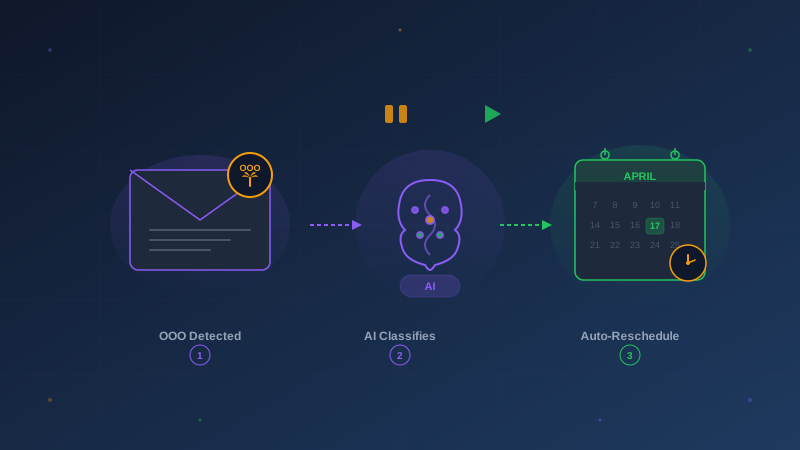
Detection is only half the problem. The other half is acting on it without requiring a human in the loop. Here’s how Underfive handles the full workflow:
Step 1: Instant classification. The OOO reply hits your inbox. Within seconds, Underfive reads it, classifies it, extracts any return date, referral contact, or role-change signal, and tags the reply accordingly.
Step 2: Sequence pause. The prospect’s active sequence is immediately paused. No more emails go out. This happens automatically — no SDR intervention required.
Step 3: Smart rescheduling. Based on the return date, Underfive calculates when to resume the sequence. It doesn’t just restart where it left off on the return date. It factors in:
- Inbox recovery time. Most people spend their first day back clearing the backlog. Your follow-up on day one back gets buried. Underfive waits 1-2 business days post-return.
- Sequence position. If the prospect was between step 1 and step 2, the agent resumes at step 2 with adjusted messaging that acknowledges the gap. If they were deeper in the sequence, it may consolidate remaining steps to avoid fatigue.
- Day and time optimization. The rescheduled send is placed at the optimal engagement window for the prospect’s timezone and historical open patterns — not just dumped back into the queue at midnight.
Step 4: Context-aware re-engagement. When the sequence resumes, the follow-up acknowledges the break naturally. Not “Hey, following up on my 4 emails from while you were gone” — something more like picking up the conversation where it would have been if the timing had been right all along.
For teams using Kali for calendar-based outreach, this rescheduling syncs with your broader scheduling strategy. If Kali identifies that a prospect typically takes meetings on Tuesdays and Thursdays, Underfive aligns the post-OOO follow-up to land ahead of those windows.
The Revenue Impact of Getting Timing Right
This isn’t a nice-to-have optimization. The numbers show real pipeline impact:
Conversion rates on post-OOO follow-ups are 22-31% higher than cold sequence averages when timed correctly. Why? Because you already know the prospect is real (they have a configured auto-reply), they work at the company (confirmed by the OOO), and they use email actively (they set up the reply). Reaching them at the right moment after they return — when they’re catching up and actually reading messages — puts you in a stronger position than the initial cold send.
Sender reputation preservation. Every stacked follow-up that gets marked as spam costs you across your entire outbound operation. One prospect who flags you affects deliverability for every other campaign running from that domain. Preventing even a handful of these incidents per month has outsized impact. If you’re already using Scrubby to keep your lists clean, adding proper OOO handling is the next layer of deliverability protection.
SDR time recovery. Two hours per week per SDR spent on OOO management, times a 10-person team, is 80+ hours per month. That’s an entire headcount worth of time being spent reading auto-replies and setting calendar reminders. AI handles it in seconds, freeing your team to work active conversations.
Pipeline accuracy. When sequences fire during OOO periods and generate no response, those prospects look like dead leads in your CRM. They’re not dead — they just weren’t there. Proper OOO handling keeps your pipeline data clean by distinguishing between “no interest” silence and “not available” silence.
What to Look For in an AI Reply Agent
If you’re evaluating tools to solve this, here’s what separates adequate from excellent:
-
Real NLP classification, not keyword matching. “I’ll be out of pocket next week” contains zero traditional OOO keywords but is absolutely an out-of-office signal. Your agent needs to understand intent, not just scan for phrases.
-
Automatic sequence integration. Detection without action is a notification, not a solution. The agent must pause and reschedule sequences natively, without requiring a human to click a button.
-
Multi-signal extraction. Return date, referral contacts, role changes, and sentiment should all be captured from a single reply. One-dimensional parsing leaves intelligence on the table.
-
Timezone and calendar awareness. Rescheduling a follow-up to “the return date” without considering day-of-week patterns and timezone is half a solution.
-
Deliverability consciousness. The agent should understand that OOO handling isn’t just about timing — it’s about protecting your sender reputation across every campaign.
Underfive was built specifically to handle these scenarios at scale. It reads every reply, classifies it in seconds, and takes action automatically — so your sequences adapt to reality instead of blindly following a preset cadence.
Stop Letting Auto-Replies Kill Your Pipeline
Out-of-office replies aren’t a nuisance to be tolerated. They’re a signal to be acted on. Every OOO contains actionable data: when to follow up, who else to contact, whether the lead is even still valid.
The teams that treat OOO replies as pipeline intelligence — and use AI to process that intelligence instantly — close more deals, protect their sender reputation, and waste fewer sends on empty inboxes.
Your sequences shouldn’t be dumber than an auto-reply. Let Underfive handle the timing so your team can handle the conversations.