Cold Email Call to Action Examples: The CTAs That Actually Get Replies in 2026
You can write a perfect opening line and a tight value prop, then lose the whole email in the last sentence. The cold email call to action is where most reps quietly kill their reply rate, because they ask for the one thing a stranger is least willing to give: a 30-minute slot on a calendar they are already protecting.
This guide breaks down the CTA types that actually earn replies, the common closers that read like a trap, and specific examples you can adapt. The point is not to trick anyone into a meeting. It is to lower the cost of saying yes so the right prospects raise their hand, then respond fast enough to keep them warm.
Why the CTA decides your reply rate
Everything above your closing line earns attention. The call to action converts that attention into an action, or fails to. A prospect can find your email genuinely relevant and still archive it because the only next step you offered felt like too much, too soon.
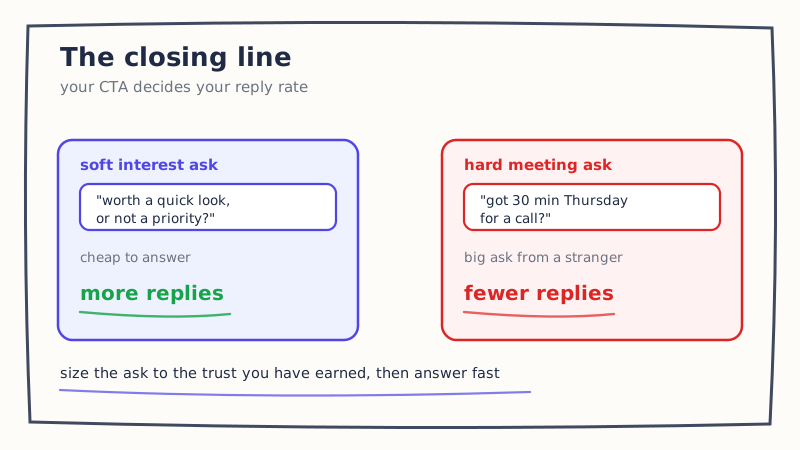
Think about the ask from their side. “Do you have 30 minutes Thursday?” asks a person who does not know you to block time, prepare, and sit through a pitch, all on the strength of one email. That is a large commitment for a cold contact. The bigger the ask, the fewer people clear the bar, and your reply rate drops even when your targeting is good. If you want more context on the gap between getting opened and getting a response, see cold email open rate vs reply rate.
The fix is not a gimmick. It is matching the size of your ask to the size of the trust you have actually earned, which at the cold stage is very little.
The two families of cold email call to action
Almost every cold email closer falls into one of two families. Knowing which one you are using, and why, is most of the battle.
Interest CTAs (soft asks)
An interest CTA asks for a reply, not a commitment. It invites the prospect to signal that the topic is worth exploring, without pinning them to a time or a call. Because the cost of answering is one sentence, more people answer.
Examples:
- “Worth a quick look, or not a priority this quarter?”
- “Is reducing [specific problem] on your radar for the next quarter?”
- “Want me to send over how [similar company] handled this?”
- “Should I send a two-line summary, or is this not the right time?”
The strength of the interest CTA is volume of replies, including “no” replies that clean your list. The tradeoff is that a “yes, tell me more” is not yet a meeting. You still have to convert that warm reply into a booked call, which is its own skill, covered in how to respond to a positive cold email reply.
Meeting CTAs (direct asks)
A meeting CTA asks for the call directly. It works best when you have some earned relevance, a warm referral, a strong trigger event, or a prospect who has already engaged. Used cold on a stranger, it filters hard: you get fewer replies, but the ones you get are more qualified.
Examples:
- “Are you open to a 15-minute call next Tuesday or Wednesday?”
- “Can I grab 15 minutes to walk you through it? Here are two times: [option A] or [option B].”
- “If it is useful, I can show you the setup live. Does Thursday at 10 work?”
The mistake is defaulting to a meeting CTA on a fully cold first touch and then blaming your list when nobody replies. Reserve the direct ask for when you have earned it, or use it later in a sequence once the prospect has seen your name a few times.
Seven CTA patterns worth stealing
These are field-tested structures, not magic words. Adapt the specifics to your buyer.
- The single yes-or-no question. “Is this worth a conversation, or should I close the loop?” It is easy to answer and it respectfully offers the exit, which paradoxically earns more yeses.
- The two-option time offer. Give exactly two slots. One choice is paralysis, ten choices is homework, two is a decision a busy person can make in five seconds.
- The permission ask. “Mind if I send a one-paragraph example?” Asking permission before sending more respects their inbox and gets a small yes that builds momentum.
- The referral redirect. “If this is not you, who owns [area] on your team?” This turns a non-buyer into a warm internal introduction instead of a dead end.
- The low-stakes resource. “Want the one-page teardown I made for companies like yours?” You trade value for a reply rather than demanding time up front.
- The soft interest check. “Not sure if this is a priority right now, is it?” Naming the likely objection lowers the guard and invites an honest answer.
- The specific-trigger call. “Saw you just [trigger event]. Open to 15 minutes on how teams handle that next?” Relevance earns the right to ask directly.
CTAs that quietly kill replies
Some closers feel productive but suppress the response you want. Watch for these.
The stacked ask. Two or three requests in one closing paragraph forces the reader to untangle what you actually want, so they do nothing. One email, one ask.
The open-ended dump. “Let me know your thoughts” or “Happy to chat whenever” hands the next move to a stranger who has no reason to make it. If you do not propose the step, no step happens. This is one of the most common reasons cold email replies get ignored before they ever start.
The calendar wall. Pasting a scheduling link into a first cold email asks the prospect to do the work of a decision you have not earned. Save the link for after they have said yes.
The vague meeting frame. “A quick sync to explore synergies” tells the reader nothing about what they get for their time. Name the concrete outcome of the 15 minutes.
The fake deadline. “This offer expires Friday” on a cold email reads as manufactured pressure and erodes trust faster than it creates urgency.
Match the CTA to the stage
A single CTA style should not carry an entire sequence. Escalate as engagement grows.
- First touch, cold: lead with an interest CTA. Your goal is a reply and a signal, not a signature.
- Second and third touches: keep it soft but add specificity, referencing the earlier angle so it does not read as a fresh blast.
- After any positive signal, an open, a reply, a click: switch to a meeting CTA with two concrete times. The prospect has warmed, so a direct ask now fits.
This is also where speed compounds. A well-placed interest CTA can produce a burst of replies, and interest decays by the hour. Teams that answer inbound in minutes convert far more of it, which is why faster response times move conversion so much. A great CTA that sits unanswered for a day is a great CTA wasted.
Where the CTA hands off to the reply
Here is the part most CTA advice skips. The CTA is not the finish line, it is the trigger for the hardest work in cold email: handling the replies it produces. A soft interest CTA is designed to generate volume, and volume means a mix of “tell me more,” “not now,” “wrong person,” and “what does this cost.” Each needs a fast, specific, human response, and each hour of delay leaks pipeline.
That is the problem Underfive was built for. Underfive reads every cold email reply, understands intent, and responds in your voice within minutes, so an interest CTA that fires at 11pm still turns into a booked meeting instead of a cold thread the next morning. It handles the qualifying back-and-forth, routes the wrong-person replies, and only pulls you in when a human is genuinely needed. You can see how the reply automation and routing works here.
The takeaway is simple. Design the CTA to make saying yes cheap, then make sure the yes gets answered before it cools. Pick one clear ask per email, size it to the trust you have earned, and give every reply a fast, specific next step.