
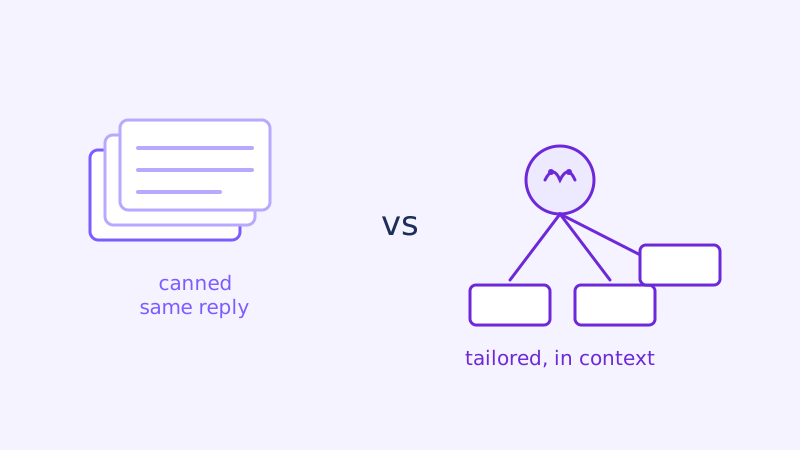
AI Reply Agent vs Autoresponder: Why Canned Replies Stall Cold Conversations
When a cold prospect finally replies, the clock starts. Respond fast and relevantly, and you have a conversation. Respond slowly, or with something that obviously ignores what they wrote, and you have a dead thread. Teams trying to handle reply volume at scale usually reach for one of two tools: a classic autoresponder with canned templates, or an AI reply agent. They look similar from a distance. They are not the same thing, and on cold outbound the difference shows up directly in your meeting count.
What an autoresponder actually does
An autoresponder is a rules engine. You write templates ahead of time, set triggers (a reply arrives, a keyword matches, a delay elapses), and the system fires the matching template. It is deterministic and fast, and for narrow, predictable flows it works fine: an out-of-office bounce-back, a “thanks, we got your message,” a fixed drip that ignores what the recipient says.
The limitation is built into the design. An autoresponder does not understand the reply. It pattern-matches. If a prospect writes “interesting, but we already use a competitor and our renewal is not until Q3,” a keyword autoresponder sees “interesting” and fires the enthusiastic book-a-demo template, or sees nothing it recognizes and fires a generic fallback. Either way it answers a question the prospect did not ask. On a cold thread, where trust is thin, that one tone-deaf reply ends the conversation.
What an AI reply agent does differently
An AI reply agent reads the actual content of the reply and composes a response to that specific message. It distinguishes a pricing objection from a timing objection from a “send me more info” from a referral to someone else, and it answers each appropriately, in your brand voice, with the relevant next step. Tools like Underfive are built specifically for this: handling cold email replies in context, deciding whether to answer, qualify, or escalate to a human, rather than firing a fixed template at every inbound message.
The practical differences for outbound:
- Comprehension, not keyword matching. The agent understands intent, so a nuanced reply gets a relevant answer instead of a template that happened to match a word.
- Multi-turn memory. It tracks the thread, so its third message still knows what was said in the first. An autoresponder treats each trigger as isolated.
- Objection handling. A pricing or timing objection gets a real, on-message response, not an upbeat demo push that reads as a bot.
- Knows when to step back. A good agent escalates the genuinely high-value or sensitive reply to a human rather than improvising, which a template system cannot judge.
Where each one belongs
This is not “AI good, autoresponder bad.” Use the right tool for the shape of the job.
Reach for an autoresponder when the flow is genuinely fixed and one-directional: acknowledgments, simple confirmations, internal notifications, a delay-based sequence where you do not need to react to what the recipient says. It is cheaper and perfectly adequate when there is nothing to comprehend.
Reach for an AI reply agent when replies are varied, unscripted, and the quality of the response decides whether a deal advances. Cold outbound is the textbook case: every positive reply is slightly different, speed matters, and a wrong-sounding answer burns the lead. The cost of a canned reply here is not a minor awkwardness, it is a lost meeting.
Why speed plus relevance both matter
People sometimes argue an autoresponder at least wins on speed, since it fires instantly. But speed without relevance does not convert; it just fails faster. A prospect who gets an instant reply that ignores their question is arguably more put off than one who waits an hour for a real answer. The reason a fast, relevant first response lifts conversion so much is that it does both at once, which is precisely what an AI agent is built to deliver and an autoresponder is not.
There is a deliverability angle too. An autoresponder that fires the same template to everyone, including invalid or trap addresses on a poorly cleaned list, racks up bounces and complaints that quietly degrade your sending reputation. Pairing reply automation with a clean list (verified up front with a tool like Scrubby so dead addresses never get mailed) keeps the inbox you are automating from getting throttled in the first place.
The takeaway
An autoresponder fires predefined messages at triggers; an AI reply agent reads what was said and responds to it. For fixed, one-directional flows the autoresponder is fine and cheaper. For cold outbound, where every reply is different and the response decides whether the deal moves, canned templates stall conversations that a context-aware agent would have advanced. Match the tool to the job: scripts for the predictable, an AI reply agent for the replies that actually matter.