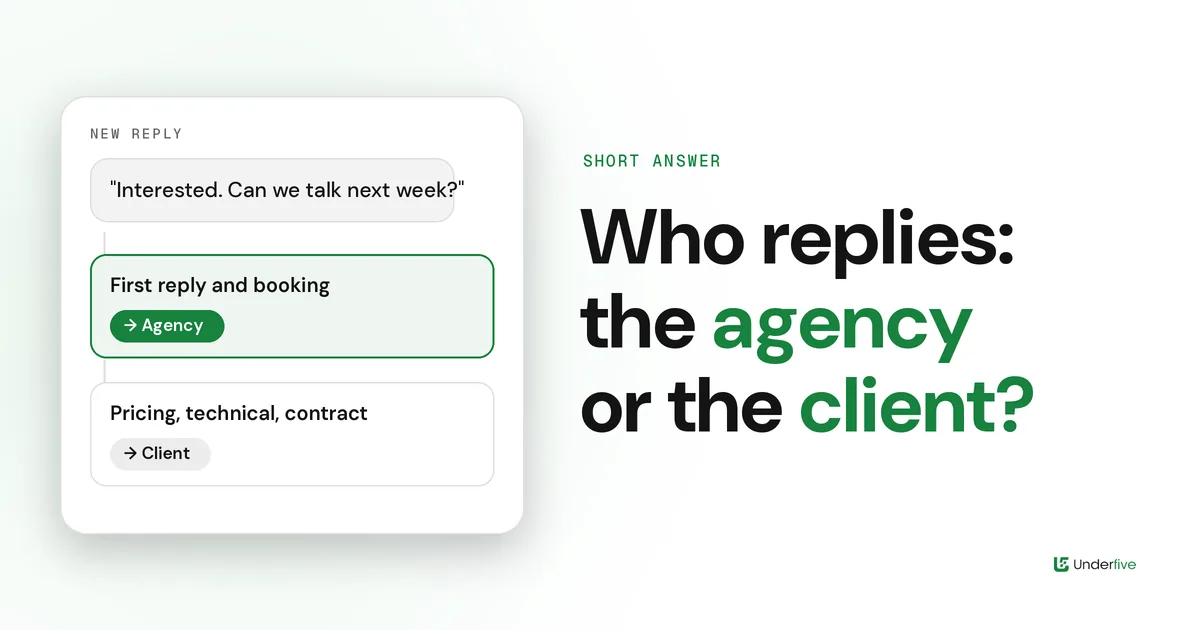
Who Should Reply to Cold Email Leads: the Agency or the Client?
In most cases the agency should handle the first reply and the booking, and the client should take over once the prospect needs something only the client can give: detailed pricing, technical answers, or a contract conversation. The agency is closer to the campaign and can respond faster; the client knows the product. The split works when it is written down, with clear escalation rules, so no reply waits while each side assumes the other has it.
Why the agency usually owns the first reply
The agency already watches the sending mailboxes, knows what each prospect was sent, and can staff for speed. Clients usually route replies to busy sales reps who answer between calls. Since speed is one of the few things that reliably affects whether a warm reply becomes a meeting, the first response belongs with whoever can answer fastest. See why reply SLAs matter for cold email.
When the client should own replies instead
Hand replies to the client from the start when:
- The sale is highly technical and almost every reply asks a product question
- The prospect list includes the client’s existing customers or strategic accounts
- The client is in a regulated industry and needs to approve what is said
- The client has a responsive sales team that wants to own the conversation
How the split usually works
| Situation | Agency | Client |
|---|---|---|
| Positive reply, wants a meeting | Replies and books | Takes the meeting |
| Question covered by approved answers | Replies | Reviews in weekly report |
| Question not covered | Escalates with context | Answers or supplies the answer |
| Unsubscribe or opt-out | Removes immediately | Nothing needed |
| Existing customer or strategic account | Escalates | Owns the reply |
| Hostile or legal reply | Escalates, does not reply | Decides |
The details of setting this up are in our client reply desk onboarding checklist and the guide to AI reply agent human escalation rules.
What goes wrong with each extreme
Client-only replies often mean slow responses, inconsistent follow-up and an agency that cannot see what happened to the leads it generated, which makes campaigns harder to improve.
Agency-only replies with no escalation path mean prospects get confident answers to questions the agency should not be answering, and the client finds out later.
Where AI inbox agents fit
An AI inbox agent can take the agency’s side of the split: sorting replies, answering the covered questions in the client’s voice, and booking meetings, while escalating everything else to a person. How much it does unsupervised should depend on the client; AI inbox agent autonomy levels covers how to choose.
FAQ
Should the client see every reply? They should be able to. Live inbox access or a weekly summary by category keeps the client confident without making them do the work.
Who should send the meeting confirmation? Whoever booked the meeting. Mixing senders between booking and confirmation confuses prospects.
Can the agency reply as the client? Yes, if the client agrees and the replies go out from the client-branded mailboxes the campaign used. Agree tone and approved answers first.
What if the client’s team wants to reply to everything? Let them, but agree a response-time target and give the agency visibility into outcomes so campaigns can still be improved.
Underfive brings every client’s mailboxes and LinkedIn accounts into one unified inbox with AI inbox agents and human escalation built in. See how it works for agencies or book a demo.