
AI Reply Agents vs Shared Team Inbox Tools: Which Actually Moves Cold Replies Forward?
When cold replies start coming in, most teams reach for the same fix: a shared inbox tool. Front, Help Scout, Missive, or a shared Gmail label gets the team organized so replies stop falling through the cracks. It feels like the obvious upgrade, and for support teams it often is.
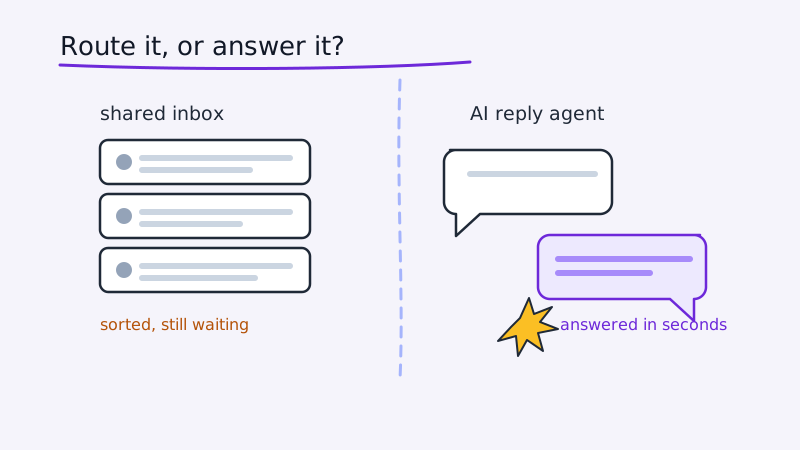
But cold outbound is not support, and the problem with cold replies is not really organization. It is speed and consistency of response. A shared inbox tells you a lead replied. It does not reply back. That gap, between knowing about a reply and acting on it, is exactly where AI reply agents and shared inbox tools part ways, and it is worth understanding before you assume the tidy inbox is the answer.
What each tool is actually for
A shared team inbox tool is a coordination layer. It takes messages flowing into one or more mailboxes and makes them manageable for a group: assignment, internal notes, collision detection so two reps do not answer the same thread, tags, and reporting. Its job is to make sure a human eventually handles each message and that the team can see who is on what.
An AI reply agent is an action layer. It reads an incoming reply, understands intent, and responds, qualifying the lead, answering a question, handling an objection, or proposing a meeting time, without waiting for a human to pick it up. Its job is not to organize the reply. Its job is to move it forward.
The distinction sounds subtle and is not. One ensures a reply gets to a person. The other ensures the reply gets a response. For outbound, where the clock starts the instant someone replies, that difference decides outcomes.
Where shared inboxes fall short for outbound
Shared inbox tools are excellent at what they were built for. The trouble starts when you ask them to carry an outbound motion they were never designed for.
They still depend on human speed. A reply lands, gets assigned, and then sits until a rep is free. Research on lead response is consistent and brutal: the odds of converting a reply drop sharply within minutes, not hours. A shared inbox that routes a reply in thirty seconds but leaves it unanswered for three hours has solved the wrong problem.
They do not handle volume spikes. When a campaign lands, replies arrive in a burst. A shared inbox shows you the pile. It does not shrink it. The team is still the bottleneck, and the slowest replies are the ones that go cold.
They are reactive by design. A shared inbox waits for a human to read, think, and type. Every reply, even the routine “what does this cost” or “send me times,” consumes a person’s attention, which means the high-value threads compete with the trivial ones for the same scarce minutes.
Consistency drifts. Five reps in a shared inbox produce five tones, five levels of qualification rigor, and five different follow-up cadences. The lead’s experience depends on who happened to grab the thread.
Where AI reply agents move the needle
An AI reply agent attacks the part a shared inbox leaves untouched: the response itself.
It responds in the window that matters. Instead of waiting in a queue, a reply gets an intelligent response in seconds, while the prospect is still in their inbox and still thinking about you. We have written before about how five-minute response times increase conversions, and an agent is what makes that speed real at scale rather than aspirational.
It absorbs volume without breaking. A hundred replies in an hour is a crisis for a shared inbox and a normal Tuesday for an agent. Every reply gets a timely, on-brand response regardless of how many arrive at once.
It triages intelligently. An agent can handle the routine threads, qualify the genuine prospects, and escalate the ones that need a human, so your reps spend their time on the conversations that actually require judgment instead of typing “happy to help, here are some times” for the fiftieth time.
It is consistent by default. One configured voice, one qualification standard, one follow-up logic, applied to every reply. The lead’s experience no longer depends on which rep was free.
This is the core of what Underfive does: read cold replies, respond in the moment with your brand voice, qualify and book where it can, and hand off cleanly when a human is genuinely needed.
The honest comparison
| Factor | Shared inbox tool | AI reply agent |
|---|---|---|
| Primary job | Organize and route replies | Read and respond to replies |
| Response speed | Limited by human availability | Seconds, automatic |
| Volume handling | Shows the pile | Works the pile |
| Consistency | Varies by rep | Uniform by configuration |
| Best at | Team coordination, support | Moving outbound replies forward |
| Human role | Answers everything | Handles escalations and judgment calls |
So which should you use?
For a support team fielding customer questions, a shared inbox is the right tool, and an AI agent is a complement at best. For an outbound team, where the entire value of a reply decays by the minute and volume arrives in bursts, an AI reply agent addresses the actual constraint, while a shared inbox only makes the constraint easier to look at.
The most capable setups use both, but with the roles assigned correctly. The agent works the front line, responding instantly, qualifying, and booking. The shared inbox becomes the escalation surface where reps handle the threads the agent flags for human judgment. The mistake is treating a shared inbox as the whole solution, because organizing replies you are too slow to answer is just a neater way to lose them.
If your cold replies are getting filed faster than they are getting answered, the problem is not your inbox. It is the gap between routing and responding, and that gap is exactly what an AI reply agent is built to close.