How AI Reply Agents Qualify Leads on BANT Without Sounding Like a Form
A prospect replies to your cold email with “sounds interesting, tell me more.” This is the moment that decides whether you get a qualified meeting or waste a rep’s afternoon on a tire-kicker. The instinct, especially when automating, is to fire back a battery of qualifying questions. Budget? Authority? Timeline? Team size? The prospect reads it, feels processed, and ghosts.
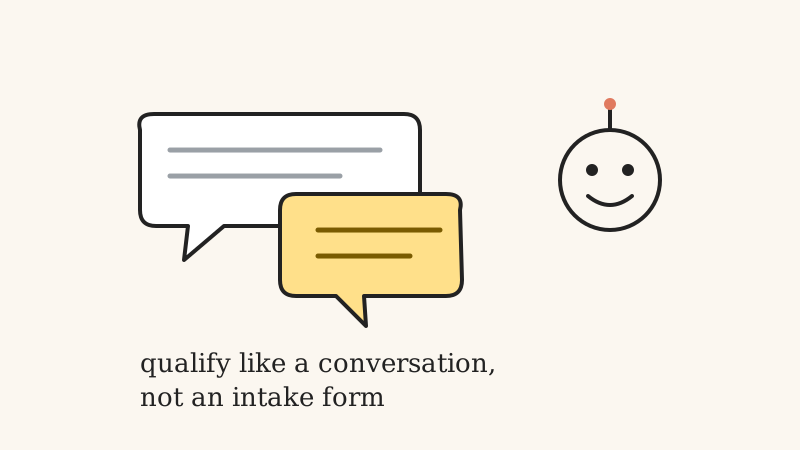
The problem is not the questions. BANT (budget, authority, need, timing) is a perfectly reasonable framework. The problem is the delivery. Humans who are good at qualification never ask all four at once. They extract them across a conversation, one at a time, in a way that never feels like an intake form. A well-built AI reply agent can do exactly the same thing, and the design choices that make it feel human are learnable.
Why batch questioning kills the reply
When you send four questions in one message, you create three problems simultaneously. You raise the effort required to respond, you signal that the prospect is being screened rather than helped, and you front-load the relationship with extraction before you have delivered any value. Each of those alone lowers reply rates. Together they collapse the conversation.
A good rep avoids this instinctively. They answer the prospect’s actual question first, then ask one thing, then listen, then ask the next thing only when it is relevant. The AI reply agent has to be designed to do the same, which means resisting the temptation to “be efficient” by gathering everything in one shot.
Designing the agent to qualify conversationally
The shift is from a questionnaire to a state machine that holds a goal. The agent knows it needs to learn four things, but it treats them as objectives to be satisfied opportunistically, not a sequence to be marched through. A platform like Underfive is built around this idea: the reply agent carries the qualification goals as context and decides, turn by turn, which one is natural to pursue next.
A few design principles make the difference:
Answer before you ask. Every agent turn should first address what the prospect actually said. Qualification questions ride along after value is delivered, never before.
One question per turn, maximum. The agent picks the single most relevant unknown and asks only that. If the prospect’s last message already revealed timing, the agent does not re-ask it; it moves to the next gap.
Infer instead of interrogate where possible. Authority often reveals itself in how a prospect talks (“I will need to run this by our VP” tells you they are not the final decision-maker without you ever asking). A well-designed agent extracts these signals from the language rather than demanding them outright.
Hold the thread. If a prospect dodges the budget question, the agent should not repeat it next turn like a stuck form. It should continue the conversation and return to the gap later, when there is more trust and more context.
A natural BANT extraction, turn by turn
Here is what conversational qualification looks like in practice. The prospect says “tell me more.” Instead of a question battery:
- Turn one answers their implied question with a sharp, specific value statement, then asks the single most useful thing: what prompted them to reply now. That one question often surfaces need and timing at once.
- Turn two builds on their answer, adds relevant proof, and naturally probes scope (“are you looking at this for just your team, or more broadly?”), which hints at authority and deal size.
- Turn three, once there is real engagement, addresses the practical path forward, which is where budget and timing clarify themselves through the discussion of next steps.
By the time the agent proposes a meeting, it has the BANT picture, and the prospect never once felt screened. The conversation did the qualifying.
Where the handoff matters
Conversational qualification is only valuable if the qualified leads convert into booked time before they cool. The agent that nurtures a great conversation and then drops the prospect into a slow manual scheduling loop has wasted its own work. Wiring the reply agent directly into a fast calendar-booking step (the kind of motion tools like Kali are built for) keeps the momentum from reply to meeting intact.
And none of this works if the conversation never starts because the email bounced. The cleanest reply agent in the world cannot qualify an address that does not exist, which is why validating your list with something like Scrubby before the campaign is the unglamorous prerequisite to every conversation downstream.
The real unlock
The point of an AI reply agent is not to automate interrogation at scale. It is to give every inbound and every cold-email reply the patient, one-question-at-a-time qualification that your best rep does on their best day, applied consistently across every conversation at once. Build it to talk like a person, and it qualifies like one. Build it to behave like a form, and prospects will treat it like one, by closing the tab.