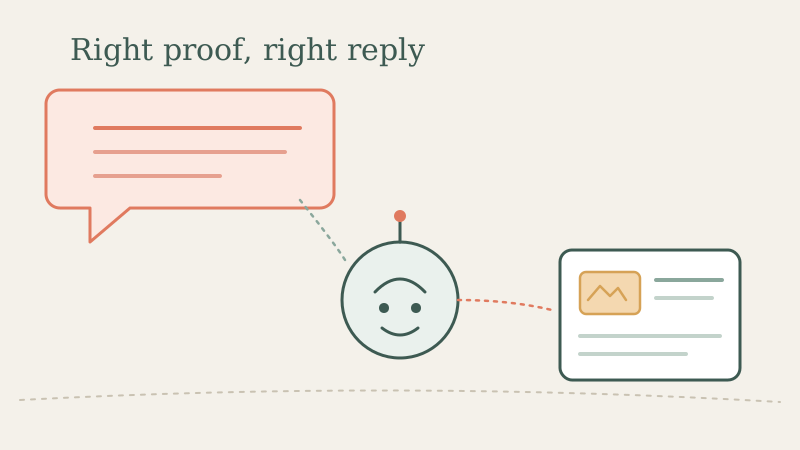
How AI Reply Agents Handle ‘Send Me a Case Study’ Replies
There is a moment in a cold email thread where the prospect stops evaluating whether they should talk to you and starts evaluating whether they can trust you. The clearest sign of that shift is a reply like this:
“Do you have a case study for a company like ours?”
Or a version of it: “Can you share a couple of references I could talk to?” or “Have you worked with anyone in fintech?”
This is not a brush-off. Unlike the vague “send me more info” reply, a request for a case study or references is usually a buying signal in disguise. The prospect is picturing the purchase and looking for evidence that someone like them made the same call and did not regret it. Handle it well and you accelerate the deal. Handle it lazily, by pasting the same three logos you send everyone, and you tell them you were not really listening.
The trouble is that these replies arrive at all hours, across dozens of threads, and the right answer changes with every prospect. That is exactly the kind of pattern a Unified Inbox with AI inbox agents like Underfive is built to handle: reading the intent behind the request and returning proof that actually fits.
Why the ‘case study’ reply is harder than it looks
On the surface it seems simple. The prospect wants a case study, so you send a case study. But a good response depends on three things that a canned auto reply cannot know.
Relevance. A logistics prospect does not care about your marketing agency win. If the proof is not close to their industry, company size, or use case, it reads as filler. The wrong case study can actually lower trust because it signals you either did not read their situation or do not have a relevant customer.
Timing in the deal. A reference request early in a conversation means “prove you are real.” The same request late in the cycle, after pricing, often means “I need something to show my boss.” Those call for different assets and different framing, even when the underlying case study is identical.
The unspoken objection. Very often the request hides a specific worry. “Have you worked with regulated industries?” is really “will you pass our security review?” A strong reply answers the question underneath the question, not just the literal ask.
A static template flattens all of this into one generic PDF. That is why so many “interested” leads go cold right after receiving the deck they asked for.
How an AI reply agent reads the request
An AI reply agent treats the incoming message as data to interpret, not a keyword to match. When a case study or reference request lands, it works through a few steps in sequence.
First, it classifies the intent. The agent distinguishes a genuine proof request from a soft no and from a due diligence ask. This matters because the same words can mean different things depending on the thread so far.
Second, it pulls context from the conversation and the record. The prospect’s industry, role, company size, and any pain points mentioned earlier all shape which proof point is the strongest. If the prospect said in message two that their SDR team is drowning in replies, the agent knows to lead with a customer who solved that exact problem.
Third, it selects the closest-matching proof from an approved library rather than defaulting to the flagship logo. A good agent ranks assets by fit, not by fame.
Fourth, it frames the asset with a one-line bridge that connects the story to the prospect’s situation, then adds a gentle next step. The case study is never sent naked. It arrives with a reason to read it and a reason to reply.
What a strong AI-generated reply actually looks like
Say a VP of Sales at a mid-market SaaS company replies: “Interesting. Do you have any results from companies our size?”
A weak reply attaches a generic one-pager and says “Here you go, let me know if you have questions.” A strong AI reply agent produces something closer to:
“Great question. The closest match to your situation is a Series B SaaS team that was getting more inbound replies than their three SDRs could work. In the first month they cut average reply time from nine hours to under five minutes and booked 22 percent more meetings from the same volume. Short version is here [link]. If it is useful, I can walk you through how the setup would map to your team in about 15 minutes this week.”
Notice what the agent did. It picked a customer that mirrors the prospect, led with the outcome that matches their likely pain, kept the asset to a digestible summary, and attached a low-friction next step. That is a reply written for one person, generated in seconds, at any hour.
Handling the reference request specifically
Asking to speak with an existing customer is a higher-stakes version of the case study reply. It usually means the prospect is serious, so the worst outcome is a slow or clumsy response.
AI reply agents handle this well when they are configured with clear rules for it. Live references are a limited resource, so most teams do not want the agent handing out contacts automatically. Instead, a well-designed agent recognizes the request, responds immediately to keep momentum, and routes it correctly: “Happy to connect you with a customer in a similar spot. Let me confirm availability with one or two who match your use case and come back to you today.” Then it flags a human to approve the specific reference. The prospect feels a fast, confident response while the sensitive step stays under human control. This blend of instant acknowledgement and human approval is a core pattern in how Underfive keeps autonomous replies safe.
Guardrails that keep proof accurate
Social proof is only an asset if it is true. An AI reply agent must never invent a customer, a metric, or a quote. The safeguards that make this reliable are straightforward.
The agent should draw only from an approved proof library: real case studies, verified metrics, and references that have consented to be named. It should be explicitly instructed never to generate numbers or customer names on the fly. When it lacks a strong match, the honest reply wins: “We do not have a published case study in your exact vertical yet, but the closest parallel is X, and I would be glad to walk you through why it applies.”
The quality of this whole system also depends on reaching real people in the first place. Proof and personalization are wasted on invalid addresses and spam traps, which is why teams pair reply automation with clean list hygiene from tools like Scrubby so that the thoughtful replies actually land in a human inbox.
The payoff: speed plus relevance at scale
The reason the case study reply is worth this much attention is that it sits at the hinge of the deal. It is the moment trust is won or lost. Historically reps faced a tradeoff: answer fast with a generic asset, or answer well but slowly after hunting for the right story. Buyers who ask for proof are ready to move now, and a nine-hour delay while you dig up the right reference lets the moment cool.
An AI reply agent removes the tradeoff. It reads the intent, matches the closest proof, frames it for the individual, and does it in the minutes that matter, across every thread at once. The prospect gets a reply that feels handpicked because, in every way that counts, it was.
That is the difference between sending a case study and answering the question the prospect was really asking. If your team is fielding more of these replies than it can personalize by hand, that is the signal to let an AI reply agent carry the load. You can see how the inbox agents in Underfive’s Unified Inbox do it.