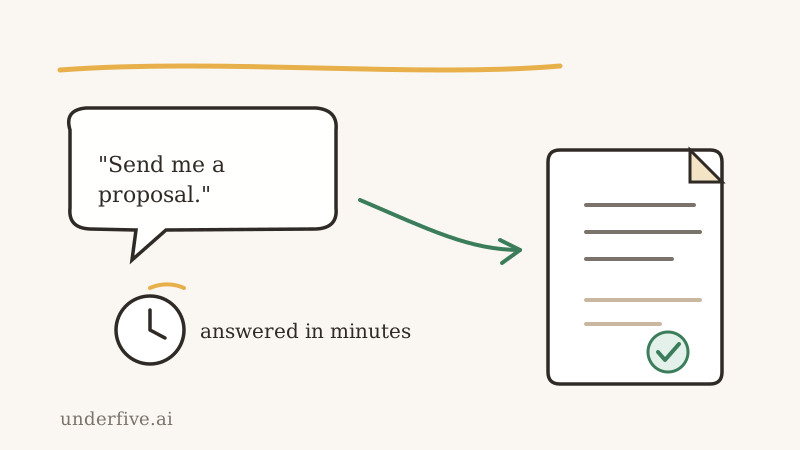
How AI Reply Agents Handle ‘Send Me a Proposal’ Replies Without Stalling the Deal
Most cold email replies are noise: out of office bounces, polite nos, “who is this?” A “send me a proposal” reply is not noise. It is one of the strongest buying signals a prospect can send you. They have read enough, they see the fit, and they are asking you to make it real on paper.
So it is strange how often that reply is exactly where the deal stalls.
The prospect writes back at 10 a.m. asking for a proposal. The rep sees it, thinks “I need to do this properly,” and files it under “later today.” Later today becomes tomorrow. Tomorrow becomes a three-day gap while the rep waits on pricing sign-off or hunts down the right template. By the time the polished PDF lands, the prospect has cooled, looped in a competitor, or simply lost the thread. A high-intent reply got treated like a low-priority task, and the momentum you spent a whole campaign building leaked away in the drafts folder.
This is the exact gap a Unified Inbox with AI inbox agents like Underfive is built to close. Here is what handling a proposal request well actually looks like, and how automation does it without turning the response into a generic template blast.
Why ‘send me a proposal’ is deceptively hard
On the surface it sounds simple: they asked for a proposal, send a proposal. But a good response to this reply has to thread three needles at once.
- Speed. Intent decays fast. The value of a reply drops sharply with every hour it sits unanswered, and we broke down the underlying data in why five minute response times increase conversions. A proposal request answered in ten minutes feels like a company that wants the deal. The same request answered in three days feels like a company you have to chase.
- Qualification. A real proposal needs inputs: team size, use case, timeline, budget range, who else is involved in the decision. Firing a generic PDF before you know any of that produces a document the prospect ignores, and often a price anchor you regret.
- Momentum. The worst outcome is a proposal that ends the conversation. You want the response to keep the thread alive and push toward a live conversation, not hand over a document and go quiet.
A human rep juggling forty other threads rarely hits all three. They either move fast and send something generic, or move carefully and move slow. An AI reply agent is designed to do both at once.
What an AI reply agent actually does with the request
When a proposal request lands, the agent does not just paste a link to a template. It runs a short, intelligent sequence in the prospect’s voice and yours.
- Responds immediately, in context. Within minutes, the prospect gets a reply that acknowledges the specific ask and reads like a sharp SDR wrote it, not an autoresponder. That alone separates you from the competitors still sitting in the same prospect’s inbox unanswered.
- Gathers the missing inputs. Instead of guessing, the agent asks the two or three qualifying questions a real proposal depends on: scope, timeline, and who needs to sign off. It does this conversationally, not as an intake form, which we cover in more depth in qualifying leads with BANT without sounding like a form.
- Anchors toward a call. For anything beyond a trivial deal, the agent nudges the prospect toward a short scoping call before the proposal, because a proposal built on a five minute conversation closes far better than one built on assumptions. It can propose times and get that call on the calendar in the same thread.
- Escalates the real ones. When the signals are strong (enterprise scope, urgent timeline, multiple stakeholders), the agent hands the thread to a human with the full context already captured, so the rep steps into a warm, qualified conversation instead of a cold “let me look into this.”
The point is not to remove the human from the proposal. It is to make sure the human never loses the deal to a slow first response, and never walks into the proposal blind.
The template trap, and how to avoid it
There is a lazy version of automating this reply, and it is worth naming so you do not build it. The lazy version detects the word “proposal” and auto-sends a boilerplate PDF and a Calendly link. It is fast, and it is worse than doing nothing, because it signals to a high-intent prospect that they are talking to a machine that did not read their message.
The difference between that and a real reply agent is context. A good agent is trained on your positioning, your objection handling, and your tone, so its response to a proposal request references what the prospect actually said and adapts to the specific deal. If the prospect mentioned they are comparing you to a competitor, the agent handles that. If they hinted at a tight budget, the agent qualifies before anchoring on price. That is a different job than keyword matching, and it is the job Underfive is built for.
Do not forget the deliverability layer underneath
One quiet failure mode: you can only respond to proposal requests you actually receive. If a meaningful slice of your campaign is bouncing off invalid addresses, the intent-rich replies never reach you in the first place, and no reply agent can work a conversation that never started. Before you optimize the reply, make sure the sends are landing. Running your list through an email validation layer like Scrubby keeps your outreach hitting real inboxes, so the proposal requests flowing into your agent come from people who exist and can actually buy.
And when the agent does book that scoping call, the follow-through matters too. Getting a clean calendar invite in front of the prospect, instead of a raw scheduling link they have to fill out, closes the loop, which is where a tool like Kali fits alongside the reply agent.
The bottom line
A “send me a proposal” reply is the prospect leaning in. The deal is yours to lose, and the most common way to lose it is a slow, generic, or half-qualified response. An AI reply agent turns that fragile moment into forward motion: an instant, contextual reply, the right qualifying questions, and a push toward a real conversation, all before a competitor even opens their inbox.
If your team is generating high-intent replies faster than reps can work them, the fix is not a better proposal template. It is an agent that owns the reply the second it lands. See how Underfive picks up your hottest replies and keeps them moving toward closed.