AI Reply Agent vs Reply.io: Which Actually Handles Your Cold Email Replies?
Reply.io has been a fixture of the cold outreach world for years. It sends multichannel sequences across email, LinkedIn, and calls, and it does that job well. So when teams start looking for something to handle the replies those sequences generate, Reply.io is a natural place to look first.
The problem is that sending sequences and handling replies are two genuinely different jobs, and confusing them costs you meetings. This is an honest look at what Reply.io does, where it stops, and when you actually need a dedicated AI reply agent instead of a better sequencer.
What Reply.io is built to do
Reply.io is, at its core, a sequencing engine. You load a list of prospects, design a multi-step cadence across channels, and the platform fires those touches on schedule until a prospect responds or the sequence ends. It has solid list management, A/Z testing on templates, a decent native dialer, and a Chrome extension for LinkedIn.
There is also an AI layer bolted on top. Reply.io markets AI-generated sequence copy, an AI SDR product, and reply classification that sorts inbound responses into buckets like interested, not interested, or out of office. That classification is useful. It tells you a reply happened and roughly what kind it was.
Where it gets thin is the step after classification: actually writing and sending the right response, in context, fast enough to matter.
What a dedicated AI reply agent is built to do
An AI reply agent starts where the sequence ends. The moment a prospect replies, it reads the full thread, understands the intent behind the message, drafts a response in your brand voice, and either sends it or routes it to a human. It is not trying to manage your list or dial phones. Its entire job is to win the conversation that a reply opens up.
That difference in focus shows up in the details that decide whether a warm reply becomes a booked call:
- Context depth. A reply agent reads the whole thread, including the original pitch and any back-and-forth, before it writes. It is not pattern matching on a single message.
- Response speed. It replies in minutes, day or night, which is where most of the conversion lift lives.
- Negotiation. It can handle a pricing question, propose a meeting time, answer an objection, and know when to escalate a thread it should not touch.
If you want the deeper version of that argument, we covered it in why five minute response times increase conversions.
The core difference: classification versus conversation
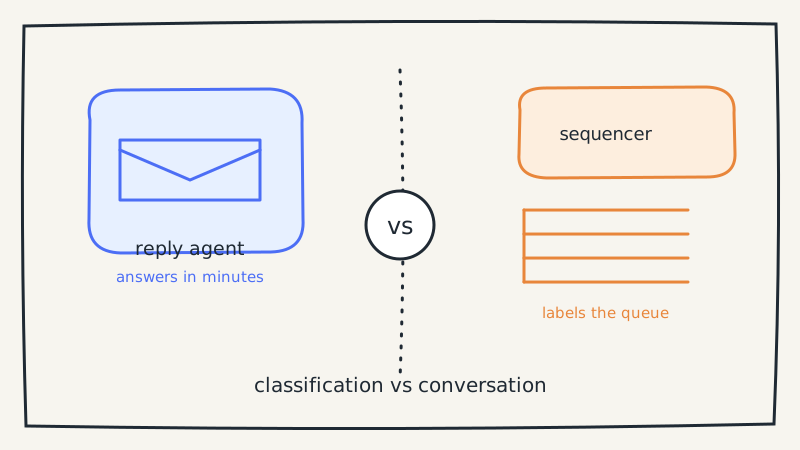
Here is the cleanest way to think about it. Reply.io’s reply handling tells you what happened. A dedicated reply agent decides what to do about it and does it.
Classification labels a reply as “interested” and drops it in a queue for a human to pick up. That is genuinely helpful, but the clock is already running. If your SDR is asleep, in a meeting, or three time zones away, that interested prospect waits hours for a response. By the time someone answers, the moment of intent has cooled.
A reply agent closes that gap. It does not just label the interested reply, it answers it, asks the qualifying question, and offers a specific time to meet, all before a human has even seen the notification. The human steps in only when the thread genuinely needs them.
Where Reply.io is the right call
To be fair, there are situations where Reply.io is the better fit, and pretending otherwise would be dishonest.
If your primary need is outbound sequencing across email, LinkedIn, and phone in a single tool, Reply.io is strong. If you have a well staffed SDR team that already answers replies quickly and you just want cleaner list management and a dialer, the classification layer may be all you need. And if your reply volume is genuinely low, the manual handoff from Reply.io’s inbox will not hurt you much.
Reply.io is a mature sequencer with a reply-labeling feature. If sequencing is the thing you are actually shopping for, it earns its place.
Where the dedicated reply agent wins
The case flips the moment reply volume or reply speed becomes your bottleneck rather than sending volume.
If your reps are drowning in inbound replies and good threads are going cold in the queue, a classifier does not solve that. It just organizes the backlog. We wrote about this exact failure pattern in when inbound reply volume outpaces SDR capacity, and it is the single most common reason teams outgrow a sequencer’s built-in reply handling.
The reply agent also wins on nights, weekends, and time zones. A prospect who replies at 9pm gets a thoughtful, on-brand response at 9:01pm instead of at 9am the next morning when three other vendors have already answered. Consistency at the reply layer is not a nice-to-have, it is where the conversion difference compounds.
Can you run both together?
Yes, and for a lot of teams that is the smartest setup. You are not forced to rip out Reply.io to add a reply agent. Let Reply.io do what it is good at, running the multichannel sequences and managing the list, and connect a dedicated reply agent to the inbox those sequences fill.
In that stack, Reply.io generates the replies and the AI reply agent converts them. The sequencer keeps the top of your funnel full, and the reply agent makes sure none of the interest it generates leaks out of a queue while a human is offline. You get the sending muscle and the conversion muscle without choosing one at the expense of the other.
A quick decision guide
Ask yourself three questions.
- Is my bottleneck sending or replying? If you cannot get enough touches out the door, invest in the sequencer. If you cannot keep up with the replies you already get, invest in the reply agent.
- How fast do warm replies actually get answered today? If the honest answer is measured in hours, a dedicated agent will move your numbers more than any sequencing tweak.
- Do good threads die in a queue overnight or over the weekend? If yes, no amount of better classification fixes it. You need something that responds, not something that labels.
Most growing teams end up needing both, but they discover it in that order: sequencer first, then a reply agent once the replies start outrunning the humans.
The takeaway
Reply.io is a good sequencer with a reply-labeling layer on top. A dedicated AI reply agent is a conversation engine that turns those labeled replies into booked meetings. They are not really competitors so much as two halves of the same funnel.
If you are evaluating Reply.io purely to handle your cold email replies, be honest about which job you are trying to fill. Classification is not conversation, and the meetings are won in the conversation. When your replies are outrunning your reps, that is the moment a purpose-built reply agent starts paying for itself. You can see how that layer works at underfive.ai.