AI Reply Agent vs Mailshake: Who Handles the Cold Email Reply?
Mailshake earned its reputation as a clean, no-nonsense sales engagement tool. You load a list, build a sequence, personalize with merge fields, and let the platform drip messages across email and phone. For the outbound half of the job, it does exactly what it promises.
But cold outreach has two halves. The first is sending. The second is answering. And these are not the same skill. Sending rewards volume and consistency. Answering rewards speed, judgment, and context. Mailshake was built for the first. An AI reply agent is built for the second. This post walks through where each one shines and where the handoff between them decides whether a reply becomes a meeting or a dead thread.
What Mailshake actually does with a reply
When a prospect responds to a Mailshake campaign, the platform does two smart things. It pauses the sequence so the prospect stops receiving scheduled follow-ups, and it surfaces the reply in your inbox or a shared view for a human to read.
That pause is genuinely useful. Nothing kills a warm reply faster than an automated follow-up landing on top of a real human question. Mailshake gets this right.
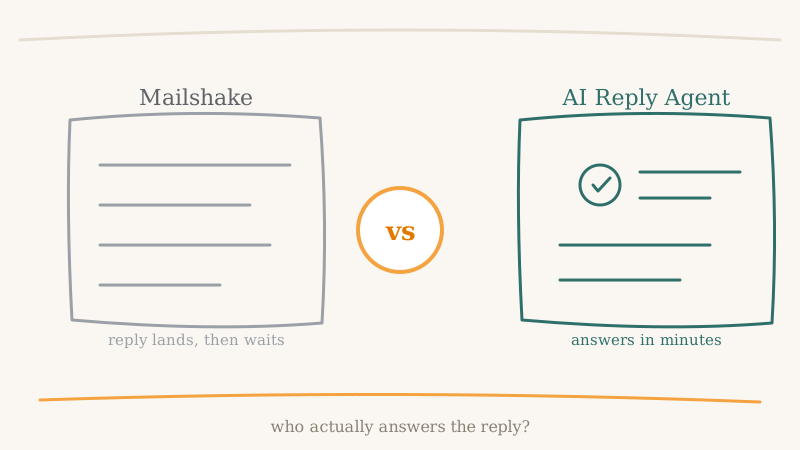
What it does not do is compose the answer. The reply sits and waits for a person to open it, read the intent, check the calendar, and write back. On a good day that takes an hour. On a busy day, or over a weekend, or when the rep is on another call, it takes far longer. And in cold outreach, the clock is the whole game.
Why the wait is the expensive part
We have written before about how five-minute response times increase conversions, and the pattern holds regardless of which sending tool fired the original message. A prospect who replies is briefly at peak interest. They just read your email, felt something, and typed a response. That window closes fast.
Mailshake can tell you a reply arrived. It cannot shorten the gap between arrival and answer, because that gap is human labor. When your reps are asleep, in meetings, or simply buried, every warm reply cools while it waits. The sequence did its job. The revenue still leaks out at the handoff.
This is the exact seam an AI reply agent from Underfive is built to close. It reads the reply the moment it lands, understands what the prospect is actually asking, and drafts or sends a contextual answer in minutes, not hours.
A side-by-side on the reply itself
Consider a common reply: “Looks interesting, but we already use a tool for this. What makes you different?”
With Mailshake alone, the sequence pauses and the message waits for a rep. When the rep gets to it, they read the thread, recall the positioning, write a differentiator, and hit send. Quality depends on which rep catches it and how much time they have.
With an AI reply agent, the reply is parsed immediately. The agent recognizes a competitor-comparison question, pulls the relevant positioning, and responds with a specific, on-brand answer while the prospect is still in their inbox. If the question crosses a threshold you defined, it routes to a human instead of guessing.
The difference is not that the agent is smarter than your best rep. It is that the agent is always awake, never buried, and answers the second reply as carefully as the first. Consistency at speed is the entire advantage.
They are not competitors, they are a relay
The framing of “AI reply agent vs Mailshake” is a little misleading, and it is worth saying so plainly. You do not replace your sequencer with a reply agent. You put them in a relay.
- Mailshake runs the outbound leg. Sequences, merge fields, send scheduling, open and click tracking. This is its strength and there is no reason to change it.
- The AI reply agent runs the reply leg. It picks up the instant a prospect answers, handles the back-and-forth, qualifies intent, handles objections, and books time.
Before either leg matters, the list has to be clean. A sequence fired at dead or invalid addresses burns your domain reputation and produces zero replies to answer. Running your list through Scrubby before the campaign starts keeps bounce rates down so the replies that do come back are real people worth answering fast.
When the reply agent qualifies a prospect and it is time to lock in a slot, a calendar-first tool like Kali turns “yes, let us talk” into a confirmed invite without the usual three-email scheduling dance. Sequence, answer, book. Each tool owns the leg it is best at.
What to look for when you add a reply layer
If you already run Mailshake and want to close the reply gap, evaluate any reply agent on four things:
- Response latency. How fast does it answer after a reply lands? Minutes is the target, not hours.
- Intent handling. Can it tell a pricing question from an objection from a scheduling request, and respond differently to each?
- Escalation rules. Does it know when to stop and hand a thread to a human? A reply agent without clear escalation is a liability.
- Brand voice. Does the answer sound like your team, or like a generic bot? Prospects can tell.
Mailshake will keep doing the sending job well. The question is who answers when the sending works, and right now, in most teams, the honest answer is “eventually, if someone gets to it.” Closing that gap is where the next batch of pipeline is hiding.
The takeaway
Mailshake is a good sequencer, and a good sequencer is worth keeping. But a reply is not the end of the funnel, it is the start of the conversation, and conversations do not wait politely for a rep to free up. Pair your outbound engine with an AI reply agent that answers in minutes, and the meetings your sequences earn actually get booked instead of quietly going cold in the inbox. See how the reply leg works at underfive.ai.