AI Reply Agent vs Lemlist: Who Actually Answers the Cold Email Reply?
Lemlist earned its following for good reasons. It bundles email warm-up, personalized multichannel sequences, and a shared unibox into one tool, so a small team can spin up a cold campaign that mixes email, LinkedIn, and calls without stitching five products together. If you want to get a well-personalized message in front of the right person across more than one channel, Lemlist does that job cleanly.
But if you have run Lemlist at real volume, you already know where the workflow thins out. It is not the sending. It is the reply.
The moment a prospect responds, the sequence stops for that contact and the message drops into the unibox, where it waits for a human to notice it, decode it, and write back. That handoff is where most pipeline quietly leaks. Below is an honest comparison of what Lemlist does well, what it was never built to do, and where a Unified Inbox with AI inbox agents like Underfive fits.
What Lemlist is built for
Lemlist is a campaign engine. Its core strengths all live on the outbound side of the conversation:
- Deliverability and warm-up. Its warm-up network builds sender reputation so more of your cold emails actually reach the inbox instead of the spam folder.
- Personalization at scale. Custom variables, images, and landing pages let you make a mass send feel one-to-one.
- Multichannel sequences. Chain email, LinkedIn touches, and call tasks into a single automated cadence.
- Shared unibox and reporting. Route replies into one shared inbox and track opens, clicks, and reply rates across a campaign.
Notice the pattern. Every one of those capabilities is about getting a well-crafted message into a prospect’s world at the right moment. Lemlist is very good at that. It is optimized for the send.
Where the campaign stops: the reply
Here is the mechanic that trips up most teams. In a campaign tool, an inbound reply is an exit condition. When a prospect responds, Lemlist pulls them out of the automated sequence so they do not get a robotic follow-up on top of a live conversation. That is correct behavior. You never want to auto-send “just checking in” to someone who already wrote back.
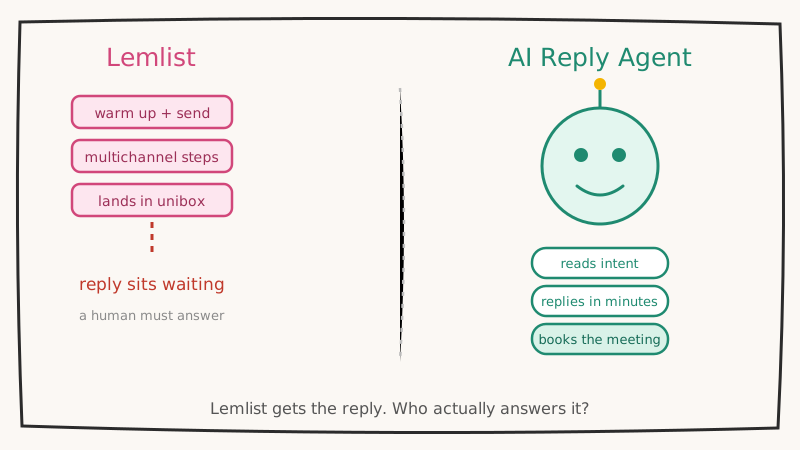
But pulling them out of the sequence and dropping the message in the unibox is the entire extent of the help. What happens next is fully manual:
- The reply sits in the shared unibox waiting to be noticed.
- A human reads it and classifies the intent: interested, pricing objection, “not now,” wrong person, out of office, unsubscribe.
- The human drafts a contextual response.
- Eventually, the human hits send.
Every step in that list is a delay, and delay is expensive. Response-time research is brutally consistent: the odds of qualifying a lead drop sharply after the first few minutes, and we break the numbers down in why five-minute response times increase conversions. Lemlist gets your message in front of someone at 9:02 a.m. If they reply at 9:05 and a rep does not open the unibox until 2 p.m., the speed advantage you paid for is already gone.
A shared unibox makes this feel handled because the replies are all in one place. It does not actually work them. Someone still has to sit down and answer each one, and that someone is the bottleneck.
What an AI reply agent does differently
An AI reply agent starts exactly where the Lemlist campaign stops. Instead of parking the reply in a unibox and waiting for a human, it monitors the inbox, reads each incoming message, understands intent, and responds in context, usually within minutes and around the clock.
Concretely, a reply agent handles the messy middle of a conversation:
- Classifies the reply. Interested, pricing question, “send me more info,” “we already use a competitor,” “circle back next quarter,” referral to another person, or a hard no. Each gets a different, appropriate response.
- Answers in your voice. It is trained on your positioning, objection handling, and tone, so replies read like a sharp SDR, not a canned autoresponder.
- Books meetings. When intent is high, it proposes times and gets the meeting on the calendar instead of firing a scheduling link into the void.
- Knows when to escalate. Genuinely complex or high-value threads get handed to a human with full context, rather than being forced through automation.
This is a different job than running a campaign. Lemlist answers “who do I reach, on which channel, and when do I send?” A reply agent answers “the prospect just responded, now what?”
They are not competitors, they are two halves of one funnel
The most useful way to think about this is not Lemlist versus AI reply agent. It is Lemlist plus AI reply agent.
| Lemlist | AI reply agent | |
|---|---|---|
| Primary job | Personalize and send campaigns | Handle the replies |
| Direction | Outbound (sending) | Inbound (responding) |
| On a reply | Drops it in the unibox | Reads, responds, books |
| Speed to respond | Depends on human availability | Minutes, 24/7 |
| Best at | Warm-up, personalization, multichannel send | Context, intent, conversation |
Keep Lemlist doing what it is great at: warming inboxes and running personalized multichannel cadences. Layer a reply agent on top so the replies those campaigns generate actually get worked, fast, instead of aging in a shared inbox. If you want the deeper version of this argument, we cover the specific failure mode in inbound reply volume outpacing SDR capacity.
Before you blame the reply agent, check the list
One important caveat. An AI reply agent can only work replies from real, reachable people. If your list is stuffed with stale or invalid addresses, even Lemlist’s warm-up will not save you: you will generate bounces instead of conversations, and no amount of reply automation fixes a deliverability problem at the source. Run your list through an email validation layer like Scrubby before you launch, so the replies flowing into your agent come from inboxes that actually exist. Clean list in, real conversations out.
The bottom line
Lemlist is excellent at the top of the outbound motion. It warms inboxes, personalizes at scale, and coordinates channels. What it does not do, by design, is carry the conversation once a prospect writes back. That gap is exactly the moment that decides whether a cold email becomes a meeting or a missed opportunity.
If your team is generating replies faster than humans can work the unibox, the fix is not a better campaign tool. It is an agent that owns the reply. See how Underfive picks up where your Lemlist campaign leaves off and turns more of those replies into booked meetings.