Klenty is one of the most popular cold outreach platforms for sales teams. It handles sequencing, follow-ups, and cadence management with polish. If you need to send 500 cold emails and make sure every non-responder gets followed up with on schedule, Klenty does that well.
But Klenty has a blind spot: it stops working the moment someone writes back.
That gap, between a prospect hitting “Reply” and your SDR actually reading and responding, is where deals stall. And it is a bigger problem than most teams realize.
What Klenty is Built For
Klenty’s core value proposition is outbound automation. You upload a list, build a cadence, and Klenty fires emails and follow-ups on the schedule you set. It integrates with your CRM, tracks opens and clicks, and removes prospects who reply (so they do not keep getting automated emails).
That last part, removing repliers from the sequence, is actually the clearest signal of what Klenty is and is not built for. Once someone replies, Klenty hands them off. What happens next is up to you and your team.
For high-volume outbound campaigns, this is a reasonable design. The sequencing problem is solved. The reply-handling problem gets kicked to your inbox.
The Reply-Handling Gap
Here is where teams run into trouble. A typical outbound campaign might generate 50 to 100 replies per week. Some are “not interested,” some are “send me more info,” some are “can we talk Thursday,” and some are “who gave you my email?”
Each of those replies needs a different response, and they need it fast. Research consistently shows that replying to a lead within 5 minutes is dramatically more effective than replying within an hour. By the time an SDR gets to their inbox, an hour may have already passed.
Klenty does not solve this. Its automation ends at the outbound phase. The inbound reply phase is entirely manual, which means your pipeline velocity depends on how quickly your reps check their inboxes and how well they handle each reply type.
What an AI Reply Agent Does Differently
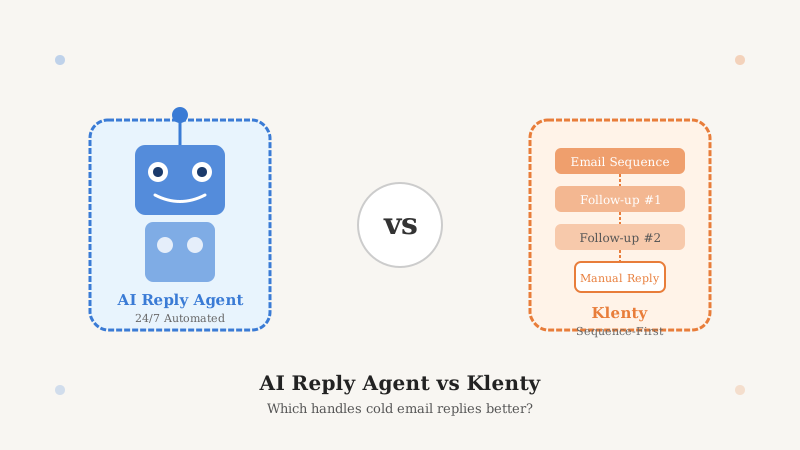
An AI reply agent like Underfive is purpose-built for the other side of the conversation. Where Klenty automates the “sending” phase, an AI reply agent automates the “responding” phase.
When a prospect replies, the agent reads the message, classifies the intent (interested, objecting, out of office, unsubscribing, asking a question), and sends an appropriate response, often within seconds. It does not just fire a canned template. It reads the actual message and replies in context.
This closes the gap Klenty leaves open. Your outbound sequence runs on Klenty, and your inbound reply handling runs on an AI agent. The two systems handle completely different parts of the workflow.
Side-by-Side Comparison
| Feature | Klenty | AI Reply Agent |
|---|---|---|
| Automates outbound sequences | Yes | No |
| Follows up with non-responders | Yes | No |
| Handles inbound replies | No | Yes |
| Classifies reply intent | No | Yes |
| Responds to objections automatically | No | Yes |
| Books meetings from replies | No | Yes (with calendar integration) |
| Works 24/7 including weekends | Sequences only | Reply handling too |
| Requires SDR to draft replies | Yes | No |
The table shows why this is not an “either/or” comparison. Klenty and an AI reply agent address different phases of the same workflow. Teams that use both get outbound coverage from Klenty and inbound reply coverage from the agent.
When Reply Speed Actually Matters
Most sales teams focus their automation budget on outbound, where the numbers are easy to track. “We sent 2,000 emails this month” is a concrete metric.
Reply handling is harder to measure, but the impact is just as real. A prospect who emails back asking about pricing and hears nothing for 6 hours often moves on. They had a moment of interest, you missed it.
The 5-minute response window matters most for warm replies, prospects who are genuinely curious or ready to book. Cold email campaigns with Underfive’s AI reply handling show consistent improvement in meeting booking rates precisely because these warm replies get answered before interest cools.
Tools like Scrubby can also help here by cleaning your list before you launch a campaign, making sure your outbound reaches real inboxes and generates real replies worth responding to.
The SDR Time Argument
One practical reason teams stay manual on reply handling is that they think SDRs handle it “anyway.” This is often true in theory and painful in practice.
SDRs are usually doing several things at once: prospecting, prepping for calls, updating the CRM, and joining team meetings. Replying to inbound emails competes with all of that. The replies that need a fast response get the same queue priority as replies that are obviously dead-end unsubscribes.
An AI reply agent removes this bottleneck. It handles every reply immediately, routes the high-intent ones to SDRs with context, and takes care of the routine ones (out of office, “not the right person,” “send me a one-pager”) without any SDR involvement.
Practical Setup: Using Both Together
If you are already on Klenty, adding an AI reply agent is additive, not a replacement. The integration path is usually:
- Klenty runs your outbound sequences and tracks engagement.
- When a prospect replies, Klenty removes them from the sequence (standard behavior).
- The AI reply agent picks up the conversation from there, handling the inbound message.
- Warm, qualified replies get flagged or forwarded to an SDR with a summary.
This setup means your team’s attention goes to the conversations that actually need a human, not to inbox triage.
Which One Should You Prioritize?
If your biggest problem is scaling outbound volume, Klenty solves that well. But if you are already sending at scale and your reply-to-meeting conversion rate is underwhelming, the bottleneck is probably not your sequences. It is your reply handling.
Optimizing your outbound cadence by 10% might get you a few more replies per month. Cutting your average reply time from 3 hours to 3 minutes can double your meeting booking rate from those same replies.
Both tools have a place. But if your sequences are already working and you are still losing leads in the reply phase, an AI reply agent is the higher-leverage investment right now.
Ready to stop losing warm replies to slow response times? Underfive handles inbound cold email replies automatically, so your pipeline keeps moving even when your team is heads-down on other work.