What Happens When You Wait 24 Hours to Reply to a Cold Email Lead
A prospect opens your cold email sequence at 2:14 PM on a Tuesday. They read the second follow-up, click through to your site, and reply with three words: “Tell me more.”
This is the moment your entire outbound operation was designed to create. The enrichment spend, the sequence writing, the deliverability work, the domain warm-up: all of it converges on this reply.
Your SDR is in a meeting until 3:30. Then they have a demo. Then end of day hits. They see the reply the next morning at 9 AM and respond 19 hours later.
The prospect never replies again.
The Data on Response Time
The relationship between response time and conversion is not linear. It is a cliff.
Research from multiple sales engagement studies shows consistent patterns:
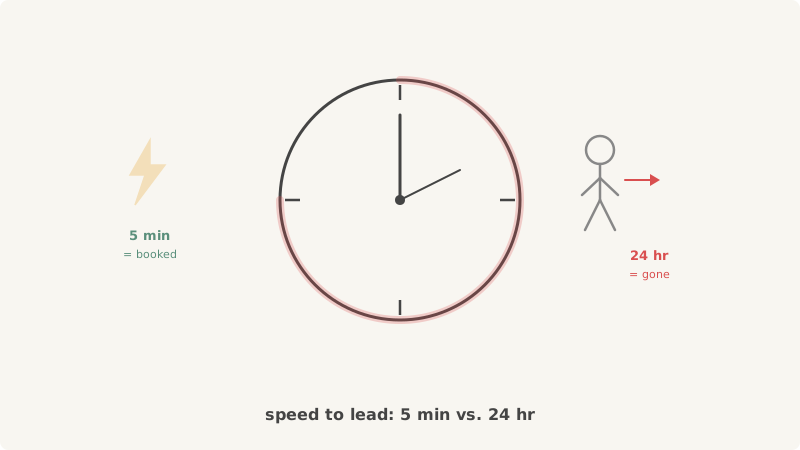
- Leads contacted within 5 minutes of showing interest are 21x more likely to enter the pipeline than leads contacted after 30 minutes
- After 1 hour, the odds of qualifying a lead drop by over 60%
- After 24 hours, most cold email replies are effectively dead. The prospect has moved on, lost the context of why they replied, or already engaged with a competitor
This data was originally studied in the context of inbound leads, but it applies even more aggressively to cold outbound. An inbound lead deliberately sought you out. They have intent and context. A cold email reply is much more fragile. The prospect was interrupted, felt a moment of curiosity, and responded. That moment of curiosity has a short half-life.
Why 24 Hours Is Too Late for Cold Email
Cold email replies are fundamentally different from inbound inquiries, and the response time requirements are stricter for three reasons:
1. The Prospect Did Not Seek You Out
When someone fills out a demo request form, they have made a deliberate decision to learn more. They expect to wait a bit. They will still be interested tomorrow.
A cold email reply is an impulse. The prospect was doing something else, your email caught their attention for 30 seconds, and they typed a quick response. If you do not capitalize on that window, the impulse fades. By the next morning, they cannot remember why they replied, or they simply do not care enough to re-engage.
2. Your Competitors Are Also Emailing Them
A typical decision-maker at a mid-market B2B company receives 10-20 cold outreach messages per week. If your email generated a reply, it means it stood out from that noise, temporarily. But the noise continues. Other sequences are running. Other SDRs are following up. If you do not respond quickly, someone else will occupy that mental real estate.
3. Context Decays Rapidly
Cold email replies are often short and context-dependent: “Interesting, let’s chat,” “What pricing looks like?” or “Tell me more.” These responses only make sense in the moment. Twenty-four hours later, the prospect has context-switched a dozen times. Picking up a conversation they barely remember starting requires more effort than most people are willing to invest.
What Happens in the First 5 Minutes
When a cold email reply gets a response within 5 minutes, the dynamic completely changes:
The conversation stays in working memory. The prospect just wrote their reply. Your email is still on their screen, or at most one tab away. They read your response immediately, and the exchange feels like a real-time conversation rather than asynchronous email tag.
Curiosity is still active. The same spark that made them reply is still warm. A fast response capitalizes on that energy before it dissipates.
Scheduling happens on the spot. When the back-and-forth is rapid, it is easy to move from “tell me more” to “let’s get 15 minutes on the calendar” in two or three exchanges. A 24-hour gap between each message means scheduling a call takes a week of email tennis.
It signals competence. A fast, relevant reply tells the prospect that your company is responsive, organized, and paying attention. It sets the tone for the entire relationship.
Why SDR Teams Cannot Solve This With Process Alone
The obvious fix is “just respond faster.” But the math does not work for human SDRs operating at scale.
An SDR running 5 active sequences across 200-500 prospects might generate 3-8 replies per day. Those replies arrive at random times: during meetings, during lunch, after hours, on weekends. The SDR cannot monitor their inbox continuously while also doing demos, research, and administrative work.
Even with email notifications enabled, there is a lag between notification and response. The SDR sees the notification, finishes what they are doing, opens the thread, re-reads the context, formulates a response, and hits send. That process takes 10-20 minutes under ideal conditions. Under real conditions (meetings, focus time, multiple tools), it takes hours.
Timezone mismatches make it worse. If your prospect is in London and your SDR is in San Francisco, a 2 PM GMT reply arrives at 6 AM Pacific. The SDR does not see it until 9 AM, seven hours later. By then the prospect is wrapping up their day and mentally checked out.
The AI Reply Agent Solution
This is the exact problem Underfive’s Unified Inbox was built to solve. An AI reply agent monitors your inbox continuously, detects when a prospect replies to a cold outreach sequence, and sends a contextually relevant response within minutes. Not a generic autoresponder. A reply that references the original email, addresses the prospect’s specific question or signal, and moves toward scheduling.
The AI agent handles the first response and the initial back-and-forth: answering basic questions about pricing, use cases, or availability, and proposing a meeting time. The human SDR takes over once the conversation requires judgment, negotiation, or deep product knowledge.
This hybrid approach solves the speed problem without replacing the human element. The AI covers the time-critical first response window. The SDR focuses on conversations that require expertise.
What Fast Response Rates Do to Pipeline Metrics
Teams that reduce their cold email reply response time from hours to minutes consistently see improvements across the funnel:
- Reply-to-meeting conversion: jumps from 15-20% to 35-45% when first response is under 5 minutes
- Meeting show rate: increases because meetings are booked while context is fresh, reducing no-shows
- Cycle time: deals that start with a fast initial exchange close faster because the prospect’s momentum is preserved
- SDR capacity: reps spend less time chasing dead replies and more time on active conversations
The compound effect is significant. If an SDR generates 100 cold email replies per month and converts 18% to meetings with a 4-hour average response time, that is 18 meetings. At a 5-minute response time with 40% conversion, that is 40 meetings from the same volume of replies. The SDR did not work harder. The system responded faster.
Protecting the Replies You Generate
Speed to lead only matters if the replies you generate are from real prospects. If your outbound list includes invalid addresses, catch-all domains with uncertain deliverability, or stale contacts, you are spending reply-time optimization effort on a smaller pool of real opportunities.
Before optimizing response time, make sure your list is clean. Tools like Scrubby validate catch-all email addresses that standard verification cannot process, ensuring the prospects who receive your emails are real people at real companies. Clean data in, faster replies out, more meetings booked.
The 5-Minute Standard
If you take one thing from this article, let it be this: your target response time for cold email replies should be under 5 minutes. Not under an hour. Not “same business day.” Under 5 minutes.
Every minute after that first 5 is leaking conversion. The data is clear, the mechanism is straightforward, and the tools to hit that target exist today. The only question is whether you build your workflow around speed or continue losing replies to delay.