How AI Reply Agents Handle ‘Send Me More Info’ Replies Without Killing Momentum
Of every reply a cold email campaign generates, “Can you send me more info?” might be the most misread. It looks like a win. The prospect engaged, they did not say no, and they even asked for something. So the rep does the obvious thing: attaches a one-pager or pastes a deck link, hits send, and waits.
Then nothing happens. The thread goes quiet. The “interested” lead never books a call.
The problem is that “send me more info” is rarely a single, clear request. Sometimes it is genuine curiosity from a buyer who wants ammunition for an internal conversation. Sometimes it is a soft no, a polite way to end the exchange without saying “not interested.” And sometimes it is a test to see whether you will actually listen or just fire a generic asset at them. The reply that wins depends entirely on which of these you are looking at.
This is exactly the kind of nuance AI reply agents are built to handle. Instead of treating every “more info” request the same way, the inbox agents in a Unified Inbox like Underfive read the surrounding context, infer the real intent, and respond with the next step most likely to keep the deal moving. This post breaks down what the reply actually means, where reps go wrong, and how an AI agent threads the needle.
What ‘Send Me More Info’ Actually Means
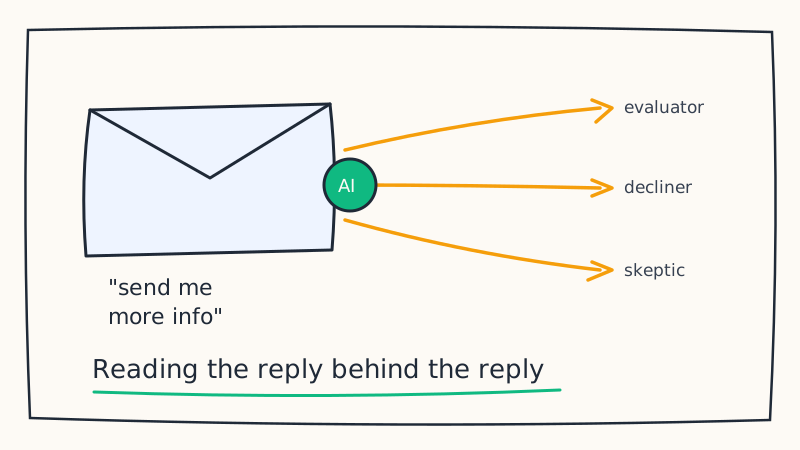
The phrase is deceptively flat. Three prospects can send the identical six words and mean three completely different things.
The genuine evaluator. This person has a problem you might solve and wants material they can review or forward internally. They are early but real. The right move is to give them something useful and specific, then create a reason to talk.
The polite decliner. This person is not interested but does not want the friction of saying so. “Send me more info” is their exit. If you respond with a wall of attachments, you confirm their instinct that this is a sales push, and they disengage for good.
The skeptical buyer. This person is interested but guarded. They have been burned by vendors who answer every question with a pitch deck. “Send me more info” is a quiet test: will you actually tailor a response to me, or will you treat me like a lead in a sequence?
A human SDR with time and attention can usually feel the difference. The problem is scale. When 40 replies land in a shared inbox on a Tuesday, nobody has the bandwidth to parse intent on each one, so every “more info” reply gets the same canned asset. The genuine evaluators get under-served, the decliners get spammed, and the skeptics get exactly the lazy response they were afraid of.
Why the Default Response Fails
The instinct to immediately send collateral feels responsive, but it quietly kills more deals than it closes. There are three reasons.
Attachments end conversations
When you send a deck or PDF, you hand the prospect everything and ask for nothing. The thread now has a natural stopping point. They said “send info,” you sent info, the transaction is complete. There is no open question pulling the conversation forward, so silence becomes the path of least resistance.
Generic collateral signals you did not listen
A prospect who mentioned a specific pain in their first reply and then receives a one-size-fits-all overview learns something about you: you are running a process, not having a conversation. That impression is hard to reverse. The skeptical buyer in particular reads this instantly and downgrades you from “maybe” to “no.”
Speed without judgment wastes the signal
Fast replies matter, but speed applied to the wrong response just gets you to the dead end faster. Firing a deck within two minutes does not help if the deck was the wrong move. The win is being both fast and correct, which is precisely where automation that includes judgment beats automation that only includes templates.
How an AI Reply Agent Reads the Intent
An AI reply agent does not see “send me more info” in isolation. It evaluates the entire thread and the prospect context to classify what is really being asked. A few of the signals it weighs:
The specificity of the original reply. Did the prospect reference a concrete problem, team size, or current tool, or did they reply with a flat one-liner? Specificity points toward a genuine evaluator. A bare, low-effort reply leans toward a polite decline.
Engagement depth. Is this the first exchange, or has the prospect already asked a clarifying question or two? Someone several messages deep who asks for info is usually building an internal case. Someone who opens with “send me info” before any real exchange may be deflecting.
Language cues. “Send me whatever you have” reads differently from “Do you have a case study for fintech teams specifically?” The first is broad and low-commitment. The second is a buying signal wearing the costume of a more-info request.
Role and firmographics. A VP asking for more info often needs something forward-able to a team. An individual contributor may be gathering quietly before escalating. The right asset and the right call to action differ by role.
From these signals, the agent forms a working hypothesis about intent and selects a response strategy to match. It is the same judgment a strong SDR applies, run consistently across every reply instead of only the ones someone has time for.
The Response Strategies That Actually Work
Once intent is classified, the agent applies a response pattern designed to keep the thread alive rather than close it out.
For the genuine evaluator: give value, then open a loop
The agent shares something genuinely useful, but pairs it with a question or a specific next step that the prospect has to respond to. Instead of “Here’s our deck,” the reply becomes something like: “Here’s a short case study from a team your size. The piece most people find relevant is how they cut response time. Want me to walk you through how that part would map to your setup?” The information is real, but the conversation stays open.
For the polite decliner: lower the stakes, do not escalate
When the signals suggest a soft no, dumping more material is the worst move. The agent instead offers a low-pressure off-ramp that keeps the door open: a single relevant link and a no-obligation “If this isn’t a priority right now, totally fine. Want me to check back in a quarter?” This respects the brush-off while leaving a clean path back if circumstances change.
For the skeptical buyer: be specific, prove you listened
The skeptic needs evidence that you actually read their message. The agent references the exact pain or context the prospect raised and tailors the response to it. Specificity is the trust signal. A reply that names the prospect’s situation and addresses it directly disarms the “they’re just pitching me” reflex and earns the next step.
In all three cases, the unifying principle is the same: never let the reply become a dead end. Every response carries a small, reasonable ask that gives the prospect a clear reason to write back.
Where the Human Stays in the Loop
None of this means the agent runs fully unattended on every thread. A well-configured AI reply agent knows when to handle a reply autonomously and when to escalate to a human. A straightforward “more info” request from a mid-funnel prospect is well within scope. A request that comes with a complex technical question, a procurement requirement, or a high-value named account is flagged for a human to take over.
This is the difference between automation that replaces judgment and automation that scales it. The agent handles the volume, applies consistent strategy, and replies fast, while routing the genuinely high-stakes moments to the people best equipped to close them. Underfive’s Unified Inbox and its inbox agents are designed around exactly this balance, taking the repetitive classification and first-response work off the team’s plate while keeping a clean handoff path for the moments that need a person.
The Deliverability Piece People Forget
There is one upstream factor that determines whether any of this matters: your replies have to actually land. The smartest, most perfectly tailored response is worthless if it hits a spam folder or bounces because the prospect’s address was never valid in the first place.
This is why reply strategy and list hygiene are two halves of the same job. Running your outbound list through a validation tool like Scrubby before the campaign goes out means the replies you get back come from real, reachable inboxes, and the careful responses your agent crafts have a clean path to the prospect. An AI reply agent makes every reply count; clean deliverability makes sure every reply arrives.
Bringing It Together
“Send me more info” is not one request. It is at least three, hiding behind the same six words, and the response that wins one will lose the others. The reflexive deck-dump treats them all the same and quietly buries warm leads in the process.
An AI reply agent changes the equation by reading the intent behind the words, matching the response to the real buyer, and keeping every thread open with a specific, low-friction next step. It applies the judgment of a great SDR at the scale of an entire campaign, and it does it fast enough to catch prospects while they are still paying attention.
If your team is sending the same generic info packet to every “more info” reply and watching those threads go cold, the fix is not a better deck. It is a smarter first response. See how Underfive handles cold-email replies with the nuance each one deserves.