How AI Reply Agents Handle ‘Is This a Bot?’ Replies (Without Losing Trust)
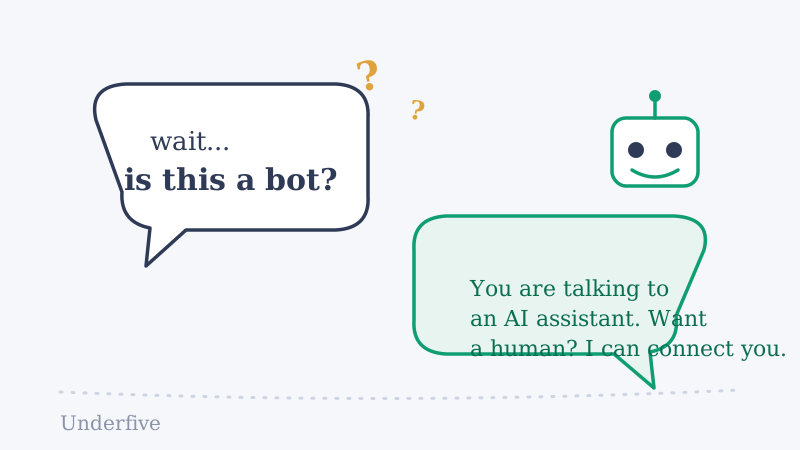
There is one reply that makes most sales teams nervous about automating their inbox at all. It is short, it is direct, and it tends to land right when a conversation is heating up: “Is this a bot?” Sometimes it is friendly curiosity. Sometimes it is a test. Occasionally it is a trap, set by a prospect who already suspects the answer and wants to see whether you will lie.
How an AI reply agent handles that single line is one of the clearest tests of whether the technology is ready for real customer-facing conversations. Answer it well and the thread often gets warmer, because you have just demonstrated honesty under pressure. Answer it badly, with evasion or a flat denial, and you have not only lost the deal, you have handed the prospect a story they will repeat about your brand.
This post is about that exact moment: why prospects ask, what a good answer actually looks like, and how a well-configured agent turns a suspicious question into a trust-building one. If you want the broader picture of when an agent should hand off entirely, Underfive handles that escalation logic as part of the same system.
Why Prospects Ask in the First Place
Before you can answer the question well, it helps to understand what is really behind it. “Is this a bot?” is almost never just a factual query. It is usually one of four things.
A tell-tale slip. The prospect noticed something. A reply that came back in nine seconds at 2 a.m. A response that answered a question they did not quite ask. A tone that felt a little too even. They are not accusing you of anything yet, they are checking whether their pattern-matching is right.
A trust gate. Some buyers simply will not invest energy in a conversation with software. Asking outright is how they decide whether to keep typing or close the tab. For these people, the honest answer is what unlocks the rest of the relationship, not what ends it.
A capability probe. A more sophisticated prospect, often technical, is curious how good the system is. They may even be evaluating you as a potential vendor of similar technology. For them, a graceful, transparent answer is itself a product demo.
A loaded test. The least friendly version. The prospect is fairly sure they are talking to an agent and wants to catch you denying it. This is where most poorly configured automations fail catastrophically, and where honesty pays the biggest dividend.
The common thread across all four is that the prospect is deciding whether you can be trusted. The content of your answer matters less than whether it is truthful and human in spirit.
The One Rule That Cannot Be Broken: Never Deny It
If you take nothing else from this article, take this. An AI reply agent must never claim to be a human when asked directly. Not “Yes, this is Sarah from the sales team” when there is no Sarah typing. Not a dodge engineered to imply a person without quite saying so.
There are three reasons this rule is absolute.
First, it is increasingly the law. Regulations like California’s Bot Disclosure Act already require that automated systems identify themselves when a person asks whether they are talking to a bot in a commercial context, and similar transparency rules are spreading. A denial is not just bad manners, it can be a compliance violation.
Second, denials get discovered. Prospects screenshot. They post the exchange. A brand caught insisting its bot is a human does not lose one deal, it loses the trust of everyone who sees the screenshot. The asymmetry is brutal: honesty costs you almost nothing, a caught lie costs you reputation you cannot easily rebuild.
Third, the denial usually does not even work. The prospect who asked already suspected. Confirming their suspicion with a lie just proves they were right and that you were willing to deceive them. You converted a recoverable moment into an unrecoverable one.
So the foundation of handling these replies is simple to state and non-negotiable to configure: when asked, the agent discloses. The craft is in how.
What a Great Disclosure Answer Looks Like
Disclosing does not mean killing the momentum. The goal is to confirm the truth, reassure the prospect that a human is reachable, and keep the conversation moving in one motion. A strong answer has three parts.
1. A clear, unembarrassed confirmation. “Good eye, yes, you are talking to Underfive’s AI assistant.” No shame, no over-explaining. Owning it confidently signals that the company has nothing to hide and has thought this through.
2. A statement of value and limits. “I handle the back-and-forth so you get answers in seconds instead of waiting days, and I loop in a person the moment anything needs real judgment.” This reframes the bot from a gimmick into a benefit: speed now, human depth when it matters.
3. An open door to a human. “Want me to connect you with someone on the team directly? Happy to set that up.” Offering the human escalation unprompted is the single most disarming move available. It tells the prospect they are in control, which is exactly what the question was really about.
Compare that to the two failure modes. The denial (“No, this is a real person”) destroys trust. The cold dump (“I am an automated system. Goodbye.”) kills momentum by treating disclosure as an exit rather than a transition. The good answer does neither: it is honest, warm, and forward-moving.
How the Agent Knows It Is Being Asked
Handling these replies well at scale depends on detection, because “is this a bot?” rarely arrives in those exact words. Prospects phrase it a hundred ways: “Am I talking to a real person?” “Is this automated?” “lol is this AI?” “Who am I actually speaking with?” Sometimes the doubt is implicit, buried in a sarcastic “wow, fast reply, are you a robot?”
A capable agent recognizes the intent rather than matching a keyword. That means classifying the reply as a meta-question about the conversation itself, separate from the sales topic, and routing it to the disclosure behavior instead of trying to answer it like a product question. Get this wrong and the agent cheerfully responds to “are you a bot?” with a pitch about features, which is its own kind of tell.
This is the same intent-detection layer that lets an agent tell a pricing objection from a scheduling request from a flat no. Recognizing the bot question is just one more category it has to read correctly. We covered the broader principle of reading reply intent in our guide to defining human escalation rules, and the bot question is often a natural trigger for exactly that handoff.
Deliverability and the Reputation Angle
There is a quieter reason to take the bot question seriously, and it lives upstream of the conversation. Prospects are most likely to get suspicious, and most likely to react badly, when your outreach already feels off. Mistyped names, wrong company details, emails landing in addresses that barely exist: all of it primes a recipient to assume the whole thing is automated spam before they have read a word.
So the best defense against hostile “is this a bot?” replies starts before the first send. Clean, verified lists mean your agent is talking to real people at accurate addresses, which keeps the conversation feeling legitimate and protects the sender reputation that gets your mail seen at all. Running your list through a validation tool like Scrubby before a campaign removes the dead and risky addresses that drag down deliverability and invite suspicion. A prospect who received a relevant, correctly-addressed email is far more likely to ask “is this a bot?” out of curiosity than out of hostility, and curiosity is easy to win over.
The relationship runs both ways. An agent that handles disclosure gracefully protects your domain too, because honest, helpful replies generate fewer spam complaints than evasive or robotic ones. Transparency is a deliverability strategy as much as a trust strategy.
Configuring Your Agent for the Bot Question
Turning all of this into reliable behavior comes down to a handful of settings worth getting right before you go live.
Write the disclosure in your own voice. Do not leave it as a generic default. The confirmation should sound like your brand, match your tone, and name your company. A disclosure that reads like the rest of your copy is far more reassuring than a canned legal sentence.
Make human escalation a real path, not a promise. If the agent offers to connect the prospect with a person, that handoff has to actually happen, fast. An offered human who never appears is worse than no offer. Wire the escalation to a live rep or a booking flow so the door you opened leads somewhere.
Decide what counts as a handoff trigger. For some teams, any bot question should immediately route the thread to a human. For others, the agent confirms and continues unless the prospect explicitly asks for a person. Both are valid, but the choice should be deliberate and tested.
Pair it with a clean booking experience. When a curious prospect says “actually, yes, let me talk to someone,” the smoothest next step is a calendar invite, not a back-and-forth about availability. Tools like Kali make that handoff a single click, so the trust you just earned converts into a booked conversation instead of evaporating in scheduling friction.
The Counterintuitive Payoff
Here is what teams discover once they configure this well: the bot question stops being something to fear. In practice, a confident, honest disclosure followed by a real offer to bring in a human often produces a warmer prospect than one who never asked. You have shown them, in the highest-stakes micro-moment of the conversation, that your company tells the truth and puts them in control.
That is the whole game with AI in the inbox. The technology earns trust not by passing as human, but by being useful and honest about what it is. The prospects who ask “is this a bot?” are handing you a chance to prove exactly that. An agent built to answer them well, like the disclosure and escalation logic inside Underfive, turns the most awkward reply in your inbox into one of the most persuasive.