AI Reply Agent vs Round-Robin SDR Routing: Which Books Inbound Leads Faster?
Round-robin SDR routing was state of the art when inbound was a luxury problem. A demo request hit the form on Tuesday afternoon, the marketing automation tool fired a webhook into the CRM, the routing rule assigned it to the next SDR in rotation, and that SDR picked it up sometime between “right away” and “after lunch.” Conversion math held together because buyer expectations matched SDR capacity.
That math has broken. Inbound volume is up, buyer expectations are down to single-digit minutes, and the round-robin queue has become the bottleneck that swallows pipeline. The question every revenue team is asking right now is whether to rebuild the routing layer or replace it with an AI reply agent that handles the first response autonomously and only hands off when there is a real meeting to book.
This comparison breaks down round-robin SDR routing against AI reply agents across the metrics that actually decide whether inbound leads convert: speed, consistency, accuracy, and the size of the team you have to run.
How Round-Robin Routing Actually Performs
The round-robin pattern is conceptually simple. Inbound lead enters CRM, routing rule cycles to the next SDR in the queue, that SDR is responsible for first response, qualification, and meeting booking. In practice, it falls apart in three places.
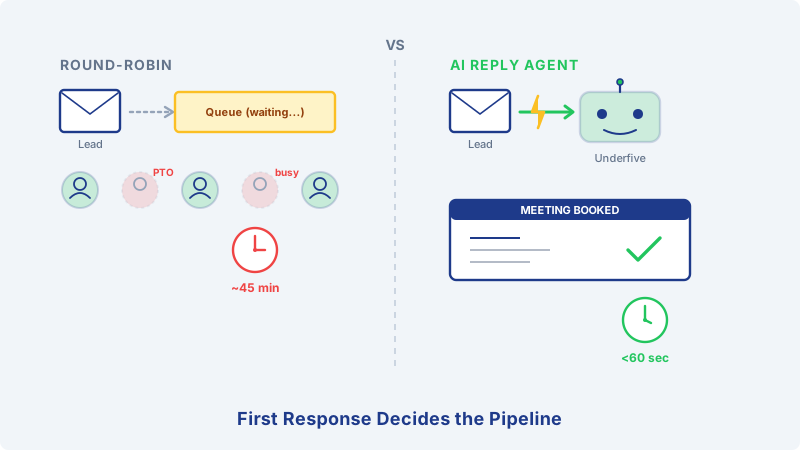
The response time distribution is brutal. When you measure round-robin response times across a real B2B inbound flow, the median often looks fine (under an hour) but the tail is catastrophic. Twenty percent of leads sit unresponded for over four hours. Ten percent stretch past 24 hours. Five percent never get a response at all because the assigned SDR is out sick, the lead got missed in the CRM view, the assignment notification went to a Slack channel nobody reads, or the SDR triaged it as “low priority” without a second look.
Speed-to-lead research has been clear for years: lead-to-contact conversion rates drop dramatically as response time stretches. The first 5 minutes capture a disproportionate share of meeting bookings. The first hour is the next cliff. After 24 hours, the lead is functionally cold. Round-robin routing produces a response-time distribution that fails on exactly the leads that are the most time-sensitive.
Consistency varies by SDR. Round-robin assigns leads evenly. SDR performance is not even. Your best SDR books 35 percent of inbound leads into meetings. Your worst SDR books 12 percent. The routing layer treats them as interchangeable, which means a third of your inbound is being handled by the SDR who is least effective at handling it. Some teams patch this with “skills-based routing” or weighted distributions, but those rules add complexity, get out of date as the team changes, and still leave the lowest-performing SDR responsible for some real share of leads.
Capacity is human. SDRs are not infinitely scalable. Each SDR can handle a bounded number of inbound leads per day before quality degrades. Hit that ceiling and the queue starts backing up, response times climb, and meeting conversion rates collapse. Teams respond by hiring, which works but takes weeks of ramp time and adds fixed cost. Inbound volume is often spiky (launch events, content viral moments, paid campaign bursts), and the round-robin layer cannot flex without a hiring cycle.
How AI Reply Agents Change the Math
An AI reply agent is not a routing tool. It is a first-touch handler that reads the inbound message, generates a context-aware human-like reply, negotiates a meeting time, books it on a calendar, and only hands off to a human SDR when the conversation has reached a meeting-booked or qualified-handoff state.
The first response time difference is the most obvious. AI reply agents respond in under 60 seconds, 24/7, including weekends, holidays, and the 3 AM window when a global prospect happens to be browsing your pricing page. That single metric collapses the response-time distribution that round-robin produces and recovers the meeting bookings that round-robin was leaving on the table in the long tail.
But the speed advantage is not the whole story. The reasons AI reply agents change the inbound math go beyond first response.
Consistency is structural. Every lead gets the same quality of first response. The AI does not have a bad day, a vacation, or an overloaded Tuesday. The variation between “best SDR handles this lead” and “worst SDR handles this lead” disappears at the first-touch layer. Human SDRs come back into the workflow at the qualified-meeting stage, where their skill at running the meeting is the part that actually matters.
Coverage is 24/7. Inbound leads do not respect timezones. A UK prospect who submits a form at 6 PM their time wants a response now, not when the New York SDR team rolls in at 8 AM the next morning. Global teams build follow-the-sun SDR rotations to handle this, which works but costs three times the headcount. An AI reply agent gives 24/7 coverage from a single configuration.
Capacity scales with traffic, not headcount. Inbound volume can double overnight from a product launch, a viral piece of content, or a paid campaign that finally clicked. Round-robin routing chokes. AI reply agents scale without hiring. The marginal cost per lead handled is functionally zero, which changes the calculation of when to run a paid campaign, when to lean into content marketing, and when to spike inbound volume intentionally.
Where Round-Robin Still Wins
Honest comparison requires naming the places where round-robin still has the edge.
Complex qualification conversations. If your inbound flow is dominated by enterprise prospects with custom requirements, multi-stakeholder threads, and conversations that need senior judgment from the first response, an AI agent will struggle. Even well-trained models cannot match a senior AE on a nuanced enterprise discovery thread. For that pattern, round-robin (or skills-based routing to senior reps) is still the right tool for the first touch.
Heavily regulated industries. Financial services, healthcare, and other regulated sectors often require disclosures, identity verification, and compliance language on every customer-facing message. AI reply agents can handle this when configured carefully (Underfive supports compliance-tuned modes for exactly this), but the configuration overhead is non-trivial. Round-robin keeps a human in the loop for first response, which simplifies the compliance posture even though it costs speed.
Very low volume. If you get 5 inbound leads per week, the operational overhead of setting up an AI reply agent might exceed the benefit. A single SDR with a fast response SLA covers it. The break-even volume is usually around 20 to 30 inbound leads per week, above which the AI agent’s leverage compounds.
For the long-tail majority of B2B inbound flows (volume between 30 and 1000 leads per week, mixed segment, standard qualification), AI reply agents now outperform round-robin routing on the metrics that matter to pipeline.
The Hybrid Pattern That Actually Wins
The smartest teams are not picking one. They are wiring AI reply agents and human SDRs into a hybrid workflow that uses each for the part it is best at.
AI handles first response and time-bound coordination. Every inbound lead gets a sub-60-second reply from the AI agent. The agent answers basic qualification questions, sends collateral if requested, negotiates meeting times, and books the calendar event. The conversation stays human-readable; the prospect cannot easily tell whether they are talking to an AI or a fast human SDR.
Human SDRs handle the meeting and the post-meeting workflow. Once the AI agent books a qualified meeting, a human SDR (or AE) takes over for the actual conversation. The handoff includes the full thread context, the questions the prospect asked, the objections raised, and any preferences the AI captured. The human runs the discovery, qualification, and demo logic on top of a meeting that the AI already secured.
Escalation rules pull humans in early when needed. When the conversation gets complex (custom enterprise requirements, security questions beyond what the AI is trained on, multi-stakeholder dynamics), the AI agent escalates to a human in real time. The hybrid lets the human spend their attention on the conversations that need it, not on the 70 percent of inbound that is straightforward.
This hybrid pattern is what Underfive’s AI reply agent is specifically designed to support. The agent handles the autonomous parts, the human SDR handles the parts that need judgment, and the routing layer becomes a coordination layer rather than a bottleneck.
What This Means for Your SDR Headcount Plan
The question on every VP of Sales’ mind is whether AI reply agents reduce the SDR headcount they need to hire. The honest answer is: yes, but not in the way most people assume.
The work that AI handles well (first response, meeting coordination, basic qualification, calendar negotiation) is the same work that consumed most of an SDR’s day on the inbound side. Replacing that workload with AI does not eliminate SDR jobs, but it changes what SDRs do. The SDR role shifts from “handle every inbound lead end to end” to “handle the meetings, the complex threads, and the post-meeting workflow that compounds into pipeline.”
In practical terms, teams that wire in an AI reply agent often hold SDR headcount flat while inbound volume doubles or triples. The same humans run a larger pipeline because the AI absorbs the work that did not need a human.
For teams that combine inbound with outbound calendar-invite-based outreach (using Kali), the AI agent on inbound frees the SDRs to spend more time on outbound campaign quality, which compounds the pipeline gains. For teams running clean inbound lists from validated sources (using Scrubby on the form-capture side), the AI agent operates on a cleaner input, which improves its meeting-booked rate from the first day.
Closing Comparison
Across the metrics that decide inbound conversion:
- First response time: AI reply agent (under 60 seconds) beats round-robin (median 30 to 60 minutes, tail to 24+ hours)
- Consistency: AI reply agent (uniform quality) beats round-robin (high variance by SDR)
- Coverage: AI reply agent (24/7 global) beats round-robin (business hours, regional)
- Capacity scaling: AI reply agent (no headcount required) beats round-robin (hire to scale)
- Complex enterprise discovery: round-robin (senior human first touch) beats AI reply agent
- Regulated industries: roughly equivalent if AI is compliance-configured; round-robin is simpler to defend
- Low volume (under 20 leads / week): round-robin is simpler
For everything in between (which is most B2B inbound flows), the AI reply agent is now the better default. The smartest teams build hybrid workflows that let AI handle the time-bound autonomous work and let humans handle the conversations that compound into pipeline. Round-robin routing is not dead, but it is no longer the right first answer for inbound at scale.