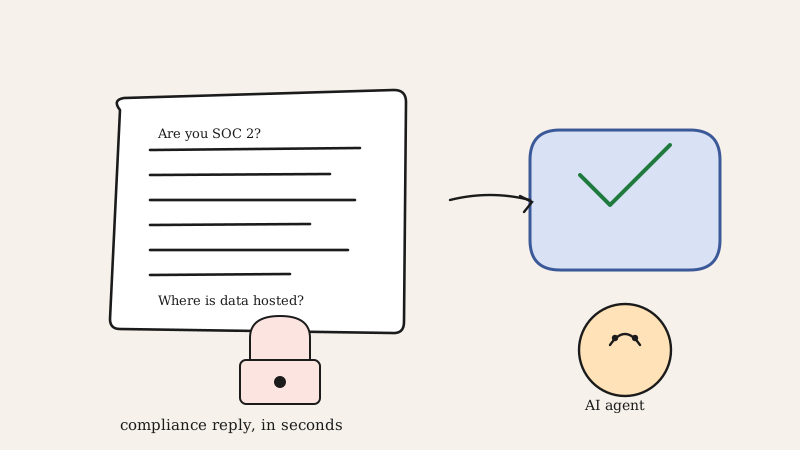
How AI Reply Agents Handle Compliance and Security Questions in Regulated Industries
A prospect at a regional bank replies to your cold email with one sentence: “Before we go any further, can you confirm your SOC 2 status, where customer data is hosted, and whether you support BAAs?” If your sales team is selling into healthcare, finance, government, or insurance, that reply is not unusual. It is the most predictable response pattern after a cold email lands inside a regulated industry.
Most outbound teams handle these replies badly. The SDR forwards it to RevOps, RevOps forwards it to Legal, Legal sends it back to Marketing, and three days later someone copy-pastes a bland answer that does not address the specific question. By that point the prospect has moved on or written you off as not enterprise-ready.
This is one of the highest-leverage problems an AI reply agent can solve, but only if you set it up correctly. Get it right and the agent fields these questions in minutes with answers that are both accurate and compliant. Get it wrong and you create legal exposure that no marketing dashboard makes up for.
Why these replies break the standard outbound playbook
Compliance and security questions break standard outbound automation for three reasons.
The answer is non-trivial. A reply about SOC 2 status is not a generic “we’d love to chat” template. It needs the actual report status, the audit firm, the period covered, and a path to share the report under NDA.
The answer is regulated. A response that misrepresents certification status is a legal risk. A response that promises a BAA you cannot honor is a worse one. This is the part where most companies either freeze or punt.
The reply window is short. Compliance teams in regulated industries process vendors in batches. If you miss the window, your evaluation gets pushed to the next quarter, which often means the next budget cycle, which often means never.
A human SDR cannot reliably hit all three constraints at sub-hour speed. An AI reply agent can, but only if it is given the right boundaries and the right knowledge base.
What the agent needs to know before it can respond
Before the inbox agents in Underfive (or any AI reply agent) can answer a security question well, you need a structured knowledge base of approved facts. This is the single biggest predictor of whether the system will work in regulated outbound.
At minimum, the knowledge base should include:
- Current certification status (SOC 2 Type II, ISO 27001, HIPAA, PCI DSS, FedRAMP) with the audit firm and the period covered.
- Data residency and hosting region options, including which clouds and which regions are available for which customer tiers.
- Encryption posture (at rest, in transit, key management) at a level of specificity that satisfies a security questionnaire without leaking architecture details.
- Subprocessors list with the most recent revision date.
- Contractual options: BAA availability, DPA template, data deletion timelines, and breach notification SLA.
- Insurance posture (cyber liability limits, professional liability) when applicable.
- An explicit set of “do not respond, escalate” topics for things only Legal should answer.
Each of these facts is short, factual, and approved. The agent does not improvise; it composes responses from this approved set.
How the agent decides what to answer and what to escalate
The system prompt for the agent should enforce three rules.
Rule 1: Match the question to an approved fact, or escalate. If the prospect asks about SOC 2, and the knowledge base contains the SOC 2 entry, the agent answers. If they ask something not in the knowledge base, the agent does not invent an answer. It says: “Good question. Let me get the right person on our compliance team to confirm this for you. I’ll have an answer back to you within one business day,” and it tags an escalation in the CRM.
Rule 2: Never make legal commitments. The agent does not promise BAAs, indemnification terms, or contract redlines. It can confirm that those instruments exist and are available; it cannot agree to specific terms.
Rule 3: Always offer the document path. Most compliance evaluations end faster when the prospect can pull the relevant report directly from a security portal under NDA. The agent’s reply should always include that path. A typical response: “Yes, our SOC 2 Type II report is current as of Q1 2026, audited by [firm]. You can download the full report after signing a one-page NDA at [link].”
This three-rule structure keeps the agent inside the lines drawn by your legal team and out of the gray area where AI reply automation gets companies sued.
The reply pattern that actually works
After watching a few hundred of these threads play out, the response shape that consistently moves regulated deals forward looks like this:
- Acknowledge the question specifically. Not “great question” but “On SOC 2: yes, we are SOC 2 Type II current as of [date], audited by [firm].”
- Give the precise factual answer. Pull the fact from the knowledge base verbatim. No paraphrasing, no embellishment.
- Offer the document path. Send the prospect to a security portal, a DPA template, or a BAA request flow.
- Reframe to the next step. “Once your team has reviewed the report, would a 20-minute call with our security lead make sense to address remaining questions?”
The reframe matters. A compliance reply that does not move the deal forward is a deal that quietly dies in the questionnaire phase.
Where this fits in the rest of the stack
Compliance replies are one of several reply types your AI agent should recognize. The pricing objection workflow is one. Out-of-office and reschedule handling is another. Disqualification (we use a competitor, not a fit, please remove me) is a third.
For the prospects who clear the compliance bar, the next step is usually a calendar conversation with a security or technical lead. Booking that meeting fast matters, and tools like Kali make calendar invites the natural next touch instead of another email back-and-forth. For the prospects who never reply at all, CAM helps you watch their organization for the trigger event (new CISO, new compliance posture, post-breach hiring) that opens the next window.
The compliance agent is not a standalone trick. It is the piece of the reply system that keeps regulated deals alive long enough to reach those next touches.
What changes when you do this correctly
Teams that wire compliance replies into their AI reply agent see three measurable improvements:
- First-response time on compliance questions drops from days to minutes. This alone moves more deals through the questionnaire phase than any single SDR change.
- Conversion from compliance reply to security review meeting roughly doubles. Speed and specificity together do most of the work.
- Legal gets pulled in at the right moments instead of every reply. Escalations only happen on questions that genuinely require human judgment.
Compliance and security questions are not the obstacle to selling into regulated industries. The slow, generic, error-prone way most teams answer them is the obstacle. Train the agent, give it the right knowledge base, draw the lines clearly, and the questionnaire phase stops killing your pipeline.