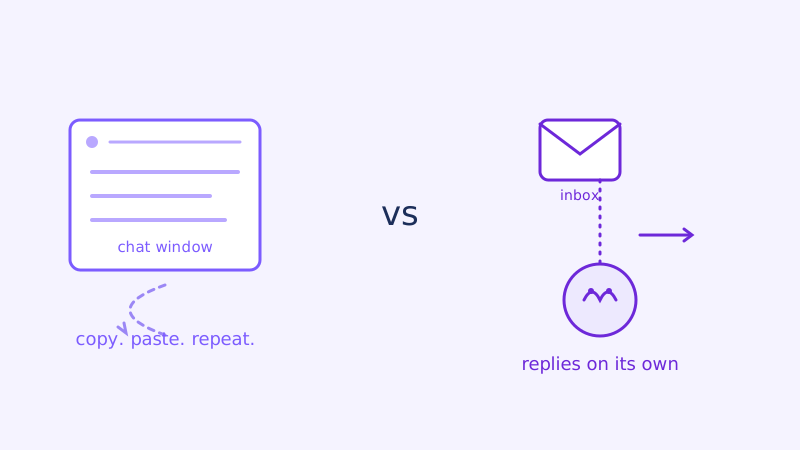
AI Reply Agent vs ChatGPT for Cold Email Replies: Why Copy-Paste Drafting Falls Apart at Scale
If you run cold outbound, you have probably already discovered the ChatGPT trick. A prospect replies, you paste their message into a chat window, type something like “write a friendly response that books a call,” copy the output back into your inbox, tweak it, and send. It feels like a superpower the first few times. The draft is decent, the tone is right, and you got it in thirty seconds instead of five minutes.
Then volume arrives. Once your campaigns are landing dozens of replies a day, the same workflow that felt clever starts to feel like a second job. This post is about where that line is, why manual prompting breaks past it, and how a purpose-built Unified Inbox with AI inbox agents like Underfive is a different category of tool, not just a faster way to do the same copy-paste.
What ChatGPT actually gives you
To be clear up front: ChatGPT is genuinely good at the writing part. Hand it a prospect’s reply and a bit of context, and it will produce a coherent, on-tone draft most of the time. For a rep handling a handful of replies a day, that is a real productivity gain, and there is no reason to stop.
The thing to notice is what ChatGPT is and is not doing. It is a general-purpose chat interface. It does not know who the prospect is, what you said in the first email, what your pricing is, or whether this person already booked a call last week. It knows only what you paste into the box each time. Every reply is a cold start. You are the integration layer: you fetch the context, you write the prompt, you carry the answer back, you decide what happens next. The model writes a paragraph; you do everything around it.
Where the manual workflow breaks
The copy-paste loop has four failure points, and they all get worse with scale.
- Context is manual every single time. ChatGPT cannot see your thread history, your CRM, or the original sequence. To get a good answer you have to paste in the prior messages and explain the situation. Skip that and the draft gets generic. Do it properly and you have just spent the time you were trying to save.
- Speed dies under load. A fast first response is one of the biggest levers in cold outbound, and replies that sit for hours convert far worse than replies answered in minutes. Manual prompting is fine at 5 replies a day and impossible at 80. The replies that arrive while you sleep, or during a meeting, or over the weekend, just wait.
- No memory across turns. Each ChatGPT session is a blank slate unless you rebuild the history by hand. On a multi-message thread, by the third exchange you are re-pasting everything to keep the model from contradicting what it said earlier.
- No decisioning. ChatGPT will happily draft a reply to anything, including the angry “take me off your list,” the legal question you should not answer, and the message from someone who is clearly not a fit. It has no concept of “this one should go to a human” or “this one should be qualified before we respond.” That judgment stays entirely on you.
None of these are flaws in the model. They are just consequences of using a general chat tool for a job that needs persistent context, automation, and routing.
What a dedicated AI reply agent does instead
An AI reply agent is built around the cold-reply problem rather than the drafting problem. The drafting is the easy 20 percent; the agent owns the other 80 percent that you were doing by hand.
Concretely, a tool like Underfive connects directly to the inbox, so it sees every reply the moment it lands, no pasting required. It carries the full thread and campaign context automatically, so a response to message four already knows what was said in messages one through three. It classifies intent before it writes: a pricing objection, a timing pushback, a referral to someone else, a “send me more info,” an unsubscribe request, each gets handled according to a rule rather than a fresh improvisation. And critically, it knows when not to answer, escalating the sensitive or high-value replies to a human instead of guessing.
The difference is autonomy versus assistance. ChatGPT assists you with one draft at a time, on your manual trigger. An AI reply agent runs the loop on its own: detect, understand, decide, respond or escalate, around the clock, across every thread, without you in the middle of each one.
A fair comparison
| ChatGPT (manual) | AI reply agent | |
|---|---|---|
| Drafting quality | Good | Good |
| Sees inbox automatically | No, you paste | Yes |
| Thread and campaign memory | Manual re-paste | Automatic |
| Responds while you are away | No | Yes |
| Classifies intent | Only if you ask | Built in |
| Knows when to escalate to a human | No | Yes |
| Best fit | A few replies a day | Reply volume at scale |
This is not “AI agent good, ChatGPT bad.” If you are handling a light, occasional trickle of replies, opening a chat window is perfectly reasonable and costs you nothing. The case for a dedicated agent appears exactly when reply volume crosses the point where being the manual integration layer stops being viable.
The part neither tool fixes for you
There is one trap worth naming. Faster, smarter replies do not help if the conversations never start, and the most common reason cold campaigns underperform is a dirty list quietly wrecking deliverability. If a meaningful share of your sends bounce or hit spam traps, your inbox reputation degrades and your good emails stop landing, no matter how sharp the reply automation behind them is. Verifying the list before you send (with a validation tool like Scrubby so dead and risky addresses never get mailed) is what keeps the inbox you are automating healthy enough to generate replies in the first place. Reply automation and list hygiene are complementary: one earns the meeting, the other makes sure the email arrives.
And once the agent has handled the back-and-forth and the prospect is ready to talk, the next bottleneck is booking. Pairing reply handling with calendar-first outreach (for example, sending a real calendar invite with a tool like Kali) closes the gap between “yes, let’s chat” and a meeting actually on the books.
The takeaway
ChatGPT is a great writing assistant and a poor reply system. It drafts well, but it has no memory, no inbox access, no intent classification, and no judgment about when to step back, so the human stays glued to the loop. That is fine at low volume and untenable at scale. An AI reply agent inverts it: the automation owns the context, the speed, the routing, and the decisioning, and a human steps in only where judgment is genuinely needed. If you are pasting cold replies into a chat window more than a few times a day, you have already outgrown the trick. The next step is a tool built for the whole job, not just the paragraph.